Have you ever wondered what makes Pentecost so special for Christians all over the world. world? This celebration is more than just a party; is a day of spiritual renewal and connection with the divine.
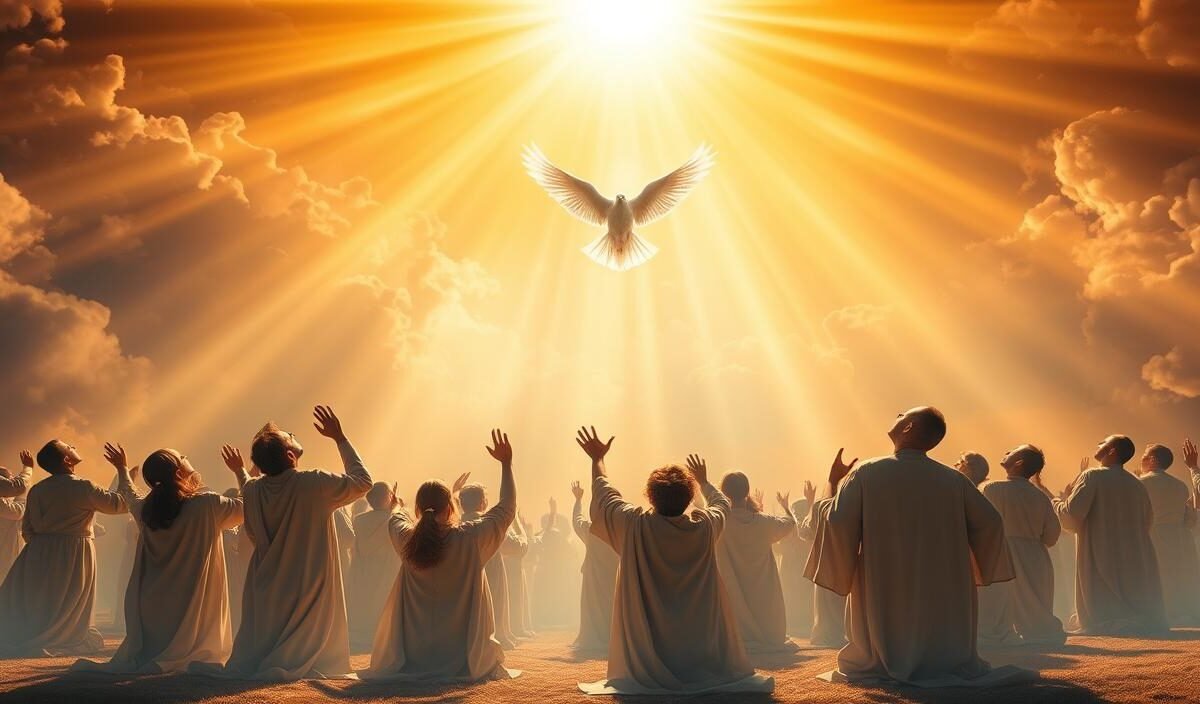
A descent of the Spirit Saint on the apostles, which took place fifty days after Easter, marked the beginning of the Christian Church and transformed the lives of Jesus' followers. This event, full of meaning, is celebrated with great celebration by Christians.
To better understand meaning of Pentecost, It is essential to immerse ourselves in the history and impact of this day. The miraculous signs, such as the strong wind and the tongues of fire, symbolized God's presence and gave the disciples the courage to spread the Good News.
What is Pentecost and Its Importance in Christianity
Pentecost is a fundamental celebration in the Christian calendar, marking the descent of the Holy Spirit. Holy Spirit about the apostles. This feast is celebrated 50 days after Easter Sunday and is considered a crucial moment in Christian history.

Origin and Meaning of the Word Pentecost
The word “Pentecost” comes from the Greek and means “fiftieth”, referring to the 50 days after Easter. This term is used to describe the party which takes place during this period, marking a significant moment in the life of the Church.
The 50 Days After Easter Celebration
The celebration of Pentecost is directly linked to the Easter period. 50 days After Jesus' resurrection, the disciples gathered together and received the Holy Spirit, which enabled them to spread the message of Jesus Christ.
Pentecost in the Christian Calendar
In the Christian calendar, Pentecost is a mobile party, The date of Pentecost varies according to the date of Easter. This means that Pentecost can take place on different dates each year, but it is always after Easter.
This celebration is significant for various Christian traditions, including Catholic, Orthodox and Protestant.
Pentecost not only commemorates the descent of the Holy Spirit, but also marks the beginning of the Church's mission. It is considered the “birth of the Church” because it transformed a group of fearful disciples into courageous preachers, ready to spread the message of Jesus Christ.
The Jewish Roots of Pentecost
Pentecost is deeply rooted in the Jewish tradition known as Shavuot or the Feast of Weeks. This celebration is a link between the old covenant and the new, providing a rich understanding of the feast.

The Feast of the Harvest or Shavuot
The Feast of Harvest, or Shavuot, was originally an agricultural celebration, marking the end of the harvest. wheat in land of Israel. It was a time of gratitude to God for harvest abundant. The Jews offered the first fruits of the land as an act of gratitude.
The Feast of Weeks in the Old Testament
In the Old Testament, the Feast of Weeks was celebrated seven times a year. weeks after Passover, totaling 50 days, which gave rise to the term “Pentecost”. This period was known as the counting of the Omer, a period of spiritual preparation.
The Feast of Weeks also commemorated the giving of the Law on Mount Sinai, a crucial event in the history of the world. people Jewish.
The Transition from Jewish to Christian Meaning
With the advent of Christianity, the Feast of Weeks or Pentecost took on a new meaning. The first Christians, being Jews, reinterpreted this feast in the light of Jesus' resurrection and the descent of the Holy Spirit. Holy Spirit about the apostles.
Thus, the celebration evolved from a feast of the harvest and the Law for a commemoration of the new covenant, sealed by the Holy Spirit.
- The Feast of Weeks or Shavuot is a celebration with deep roots in Jewish tradition.
- It originally marked the end of the wheat harvest and was an act of gratitude.
- The counting of the Omer, a period of 49 days, precedes the Feast of Weeks.
- The Jewish celebration was reinterpreted by Christians, acquiring a new meaning related to the descent of the Holy Spirit.
The Descent of the Holy Spirit on the Apostles
On the day of Pentecost, a supernatural event changed the course of Christian history. The disciples were gathered in the same place, waiting for Jesus' promise. Suddenly, a sound like a strong wind came from heaven and filled the whole house where they were.
The Biblical Account in Acts of the Apostles
The book of Atos Acts of the Apostles, chapter 2, verses 1 to 6, recounts the event of the descent of the Holy Spirit. “When the day of Pentecost came, the disciples were all gathered together in one place.
Suddenly, a sound like a strong wind came from heaven and filled the whole house where they were. Then tongues of fire appeared and spread out and fell on each of them.
They were all filled with the Holy Spirit and began to speak in other tongues as the Spirit gave them utterance.”
The Miraculous Signs: Strong Wind and Tongues of Fire

The miraculous signs that accompanied the coming of the Holy Spirit were impressive. The sound of a rushing wind and the tongues of fire that landed on each person were visible and audible manifestations of God's presence.
These signs not only frightened the disciples, but also attracted the attention of a crowd of Jewish pilgrims from different nations who were in Jerusalem for the feast of Pentecost.
The Gift of Speaking in Other Languages
The gift of speaking in other languages was one of the main results of the descent of the Holy Spirit. The apostles were able to speak in languages they had never studied, allowing them to communicate the message of Jesus Christ to people from different languages and cultures.
| Events | Description | Meaning |
|---|---|---|
| Strong wind | Noise like a strong wind filling the house | Manifestation of God's presence |
| Tongues of Fire | Tongues like fire spread out and fell on the disciples | Symbolizes purification and training for the mission |
| Speaking in Other Languages | The disciples began to speak in other languages | Effectively communicating the message of Jesus Christ to different people |



The Theological Significance of the Holy Spirit in Christian Life
As we explore the theological significance of the Holy Spirit, we understand its importance in Christian life. The Holy Spirit is the third person of the Holy Trinity, equal in essence and divinity to the Father and the Son.
St. Basil the Great emphasizes that the Holy Spirit is one with the Father and the Son, forming the omnipotent unity in God.
The Holy Spirit as the Third Person of the Holy Trinity
The Holy Spirit is considered the third person of the Trinity, being God as well as the Father and the Son. He sanctifies those who are sanctified, enlightens everyone with the knowledge of God and inspires the prophets. Your presence is essential in the life of Christians, guiding them in faith and works.
The Gifts and Fruits of the Holy Spirit
The Holy Spirit grants various gifts to the faithful, such as wisdom, understanding, counsel, fortitude, knowledge, piety and the fear of God. He also produces fruits in the Christian's life, including love, joy, peace, patience, kindness, goodness, faithfulness, gentleness and self-control.
These gifts and fruits are essential for spiritual maturity and for mission of the Church in world.
| Gifts of the Holy Spirit | Fruits of the Holy Spirit |
|---|---|
| Wisdom | Love |
| Understanding | Joy |
| Council | Peace |
| Fortaleza | Patience |
The Action of the Holy Spirit in the Church and in the World
The Holy Spirit acts as Comforter, Advocate and Guide, leading Christians to the full truth. He is fundamental in action of the Church, uniting the various members and distributing gifts for the edification of all.
In addition, the Holy Spirit continues to work in the world, convincing him of sin, righteousness and judgment. To find out more about the importance of the Holy Spirit, explore additional resources.
Conclusion: Pentecost in the Life of the Christian Today
You are about to discover how the Holy Spirit, who descended on the disciples on the day of Pentecost, is still available to you and to all Christians. The celebration of Pentecost is not just a memory of the past, but a present reality that can transform your life and ministry.
Pentecost reminds us of universality of the Church, The Holy Spirit continues to equip Christians for mission in the contemporary world, just as he did with the first disciples. The Holy Spirit continues to equip Christians for mission in the contemporary world, just as he did with the first disciples.
By understanding and embracing this truth, you can experience your own “personal Pentecost”, being empowered to witness to Christ in your context.
The annual celebration of Pentecost can renew your faith and commitment, reminding you of the continuous presence and action of the Holy Spirit in your life.
Furthermore, the spiritual principles of Pentecost, In the same way, the words of the Holy Spirit, such as waiting, unity, prayer and availability, can be applied to your walk of faith, allowing you to produce a spiritual harvest through the power of the Holy Spirit.
FAQ
Q: What is the meaning of the descent of the Holy Spirit?
A: The descent of the Holy Spirit represents the beginning of the Church's mission and the fulfillment of Jesus' promise to send a Comforter to the disciples.
Q: Why is Pentecost celebrated after Easter?
A: Pentecost is celebrated 50 days after Easter because it marks the conclusion of the Easter period and the inauguration of the Church age, symbolizing the spiritual harvest that follows Jesus' resurrection.
Q: What is the relationship between Pentecost and the Feast of Weeks in Judaism?
A: Pentecost has its roots in the Feast of Weeks, a Jewish celebration that took place seven weeks after Passover, marking the wheat harvest and gratitude to God for the fertility of the land.
Q: What do the tongues of fire that descended on the apostles mean?
A: The tongues of fire represent the visible manifestation of the Holy Spirit and symbolize the purification and empowerment of the disciples for the mission of preaching the Gospel to all nations.
Q: What is the role of the Holy Spirit in the Christian life?
A: The Holy Spirit is the third person of the Holy Trinity and plays a fundamental role in Christian life, empowering believers for mission, granting spiritual gifts and fruits and guiding the Church on its journey.
Q: How can we experience the action of the Holy Spirit in our lives?
A: We can experience the action of the Holy Spirit in our lives by surrendering to His work, seeking spiritual gifts and fruits and living in obedience to God's Word, allowing Him to guide and empower us for the mission.