Biblical quotations: Almeida Revista e Corrigida (ARC, 1898).
Matthew 4: The Journey into the Desert. After being baptized, Jesus is led by the Spirit into the desert, where he fasts for forty days and is tempted by the devil. It is one of the best-known accounts in the New Testament and offers practical lessons on faith, temptation, and trust in God.
In this article, you'll learn about the three temptations of Jesus, how he responded to each one, and what this teaches us about life today.
- the context of Matthew 4;
- the three temptations in the desert;
- Jesus' answers based on the Scriptures;
- lessons for the Christian life.
The Importance of Matthew 4
Chapter 4 of Matthew has 25 verses. The first eleven describe the temptation in the desert. The rest recount the beginning of Jesus’ ministry in Galilee and the calling of the first disciples.
A tentação acontece logo depois do batismo, quando uma voz do céu declara Jesus como o Filho amado de Deus (Mateus 3:17). Por isso o diabo começa duas das tentações com a frase
E eis uma voz dos céus, dizendo: Este é o meu Filho amado, em quem me agrado.
Mateus 3:17 — Bíblia Livre (BLIVRE)
ele ataca justamente a identidade de Jesus.
| Temptation | What the Devil Proposed | Jesus' Response |
|---|---|---|
| 1st: Stones in bread Matthew 4:3-4 | Using Power to End Hunger | Man shall not live by bread alone (Deut. 8:3) |
| 2nd: Temple spire Matthew 4:5-7 | If you gamble to prove God's protection | You shall not put the Lord your God to the test (Deut. 6:16) |
| Tuesday: Kingdoms of the World Matthew 4:8-10 | Power and glory in exchange for worship | You shall worship the Lord your God (Deut. 6:13) |
In the following sections, we'll look at each temptation in detail.
Temptation in the Desert: A Divine Test
The story begins like this:
“Então Jesus foi levado pelo Espírito ao deserto para ser tentado pelo diabo. E depois de jejuar quarenta dias e quarenta noites, teve fome.”
Mateus 4:1-2 (BLIVRE)
Jesus spent forty days and forty nights in the desert, fasting and in isolation. It was the Spirit who led him there, which shows that this period was part of the beginning of his ministry.
It was during this moment of physical weakness that the tempter appeared, offering three temptations that tested Jesus’ trust in God.
The First Temptation: Stones in Bread
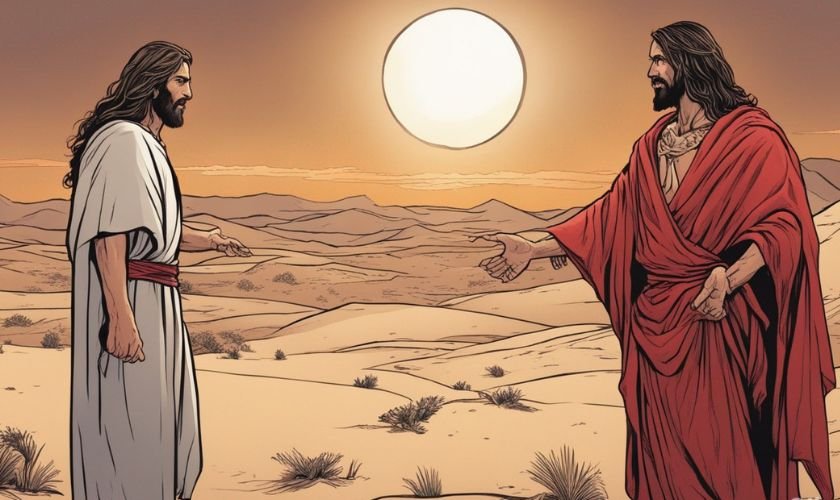
In verses 3 and 4, the first temptation occurs. Jesus was hungry, and the tempter approached him:
“E o tentador se aproximou dele, e disse: Se tu és o Filho de Deus, dize que estas pedras se tornem pães.”
Mateus 4:3 (BLIVRE)
The devil challenges Jesus to prove his identity by turning stones into bread.
The temptation goes beyond physical hunger. It suggests that Jesus use his powers to meet a personal need, rather than wait for the Father’s care.



Jesus' Response
Jesus responds with a passage from the Scriptures:
“Mas Jesus respondeu: Está escrito: Não só de pão viverá o ser humano, mas de toda palavra que sai da boca de Deus.”
Mateus 4:4 (BLIVRE)
Jesus quotes Deuteronomy 8:3, a passage that recalls the people of Israel in the wilderness, sustained by God with manna. He places the Word of God above material needs.
E te afligiu, e te fez ter fome, e te sustentou com maná, comida que não conhecias tu, nem teus pais a conheciam; para fazer-te saber que o homem não viverá de só pão, mas de tudo o que sai da boca do SENHOR viverá o homem.
Deuteronômio 8:3 — Bíblia Livre (BLIVRE)
Jesus does not use his power to meet an immediate need and continues to trust in God's will.
The Second Temptation: The Leap from the Temple Pinnacle
The second temptation, in verses 5 through 7, has an interesting detail: this time, the devil himself quotes Scripture.
“E disse-lhe: Se tu és o Filho de Deus, lança-te abaixo, porque está escrito que: Mandará a seus anjos acerca de ti, e te tomarão pelas mãos, para que nunca com teu pé tropeces em pedra alguma.”
Mateus 4:6 (BLIVRE)
The devil takes Jesus to the highest point of the temple, quotes Psalm 91:11–12, and challenges him to throw himself down so that God would save him in front of everyone. The temptation involves real physical danger and tests Jesus’ trust in God.
Porque ele ordenou aos anjos quanto a ti, para que guardem todos os teus caminhos. Pelas mãos te levarão, para que não tropeces teu pé em alguma pedra.
Salmos 91:11-12 — Bíblia Livre (BLIVRE)
Jesus responds with another passage, from Deuteronomy 6:16:
Não tentareis ao SENHOR vosso Deus, como o tentastes em Massá.
Deuteronômio 6:16 — Bíblia Livre (BLIVRE)
The Third Temptation: Worshiping the Devil
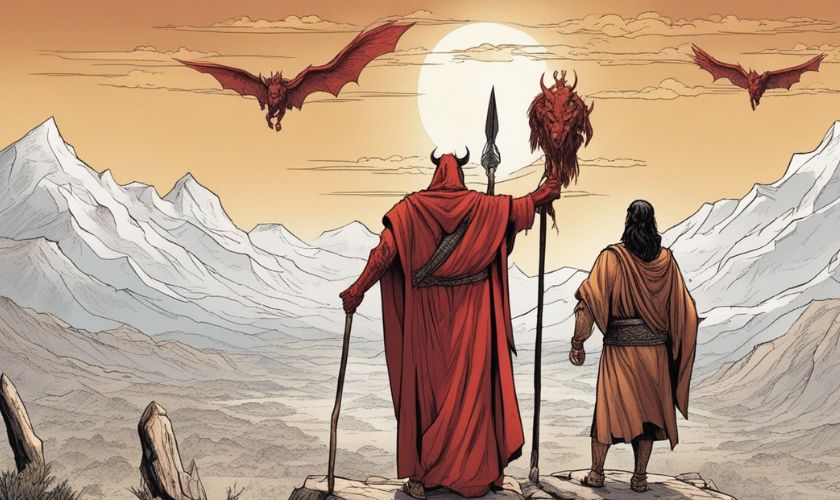
The third and final temptation, in verses 8 through 10, is the most direct. The devil takes Jesus to a very high mountain, shows him the kingdoms of the world, and makes the offer:
“E disse-lhe: Tudo isto te darei se, prostrado, me adorares.”
Mateus 4:9 (BLIVRE)
It is a temptation involving power, authority, and glory—without following the path the Father had laid out. Jesus resists once again by referring to Scripture, quoting Deuteronomy 6:13:
Ao SENHOR teu Deus temerás, e a ele servirás, e por seu nome jurarás.
Deuteronômio 6:13 — Bíblia Livre (BLIVRE)
The episode ends with Jesus' victory: in verse 11, the devil leaves him, and the angels come to serve him.
Conclusion
Chapter 4 of Matthew reveals Jesus’ humanity and divinity and teaches us how to resist temptation. With each attack, Jesus responded with the Word of God.
Some lessons that a Christian reading draws from this account:
- 📖Getting to Know the Word: Jesus responded to the three temptations with passages from the Scriptures.
- 🙏Trusting without testing: Faith trusts in God, but does not put Him to the test.
- 👑Worship God alone: No power or glory justifies giving that up.