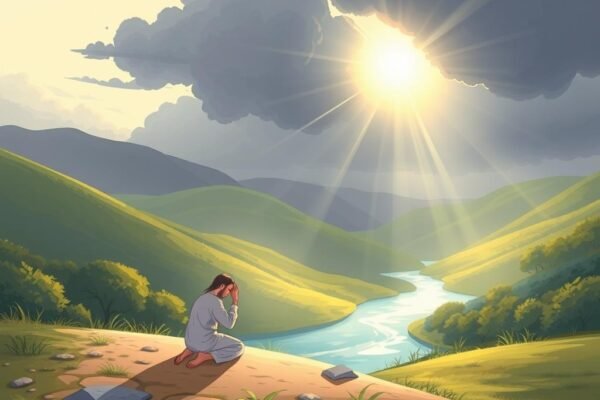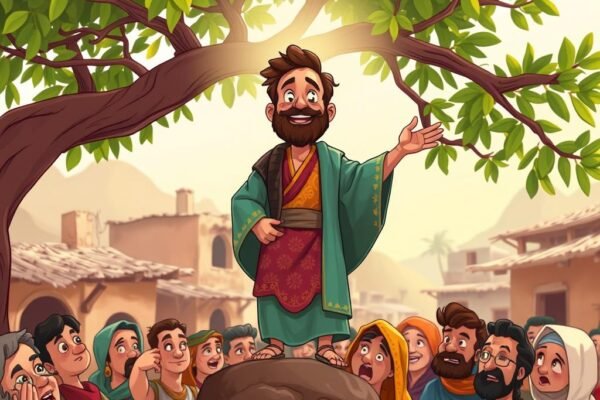

The Mystery of the Apocalypse: Have you ever wondered what the Book of Revelation really means? This book of the Bible is full of enigmatic visions and symbols intriguing.
It has fascinated scholars and readers for centuries. But what lies behind these mystical revelations e prophetic messages?
In this article, we will explore the Book of Revelation. We will discover its origins, symbolism, and significance for Christians.
Get ready to unravel the mysteries of these God-inspired pages.
So, what do you think the Book of Revelation says about the future and humanity? Let's study it together. And let's discover the surprising answers.
The Origin and Meaning of the Book of Revelation
Revelation is a book of the Bible that was written during a time of great persecution. It was written while the Roman emperor Domitian was in power.
At that time, Christians were going through difficult times, which led the author to use many metaphors in the work.
The Concept of Revelation in Biblical Literature
The word “Apocalypse” comes from the Greek “apokálypsis.” It means “revelation” or “unveiling.”.
This idea of revealing divine truths appears in many places in the Bible. For example, in the book of Daniel.
The Historical Context of the Book
The Book of Revelation was written by John around 95 AD. He was imprisoned in the Island of Patmos, in the Aegean Sea. That period was marked by persecution of christians under Domitian. That had a major influence on the book's style.
The Importance of the Book of Revelation to the Early Christians
For the early Christians, the Book of Revelation was a source of hope for ultimate victory. Even with descriptions of catastrophes, the main message is that Christ It's the center of everything.
He is the “Alpha and Omega” and the Lion of the tribe of Judah. This gave the faithful strength in difficult times.
“Blessed is the one who reads this prophecy, and those who hear its words and keep what is written in it; for the time is near.” (Revelation 1:3)
| Topic | Description |
|---|---|
| The Origin of the Book of Revelation | The book was written by João while he was in prison at the Island of Patmos, around the year 95 A.D., during a period of intense persecution of Christians. |
| Meaning of the word “Apocalypse” | The term “Apocalypse” comes from the Greek “apokálypsis,” which means “revelation” or “the act of uncovering.”. |
| Significance for the Early Christians | The Book of Revelation offered hope and encouragement to believers facing tribulation and persecution, revealing Christ's ultimate victory over the forces of evil. |
The Author and His Prophetic Perspective
John, Jesus' beloved apostle, wrote the Book of Revelation in island of Patmos. His prophetic vision came from his experience with Christ and from the prophetic visions that he had.
He used symbolism to convey divine messages about the future of the church and the world.
According to the tradition of the early church, John wrote the Book of Revelation. However, there is debate regarding stylistic differences compared to his other writings.
The Book of Revelation is full of symbolism and numbers, such as the number seven, which appears 54 times. João used these elements to share his prophetic visions about the future.
| School of Acting | Approach |
|---|---|
| Preterist | It interprets the Book of Revelation as referring primarily to events of the past, such as the persecutions of Christians in the early centuries. |
| Futuristic | He views the Book of Revelation as a prophecy about events yet to come, at the end of time. |
| Historical | He views the Book of Revelation as a historical prophecy, with events that have unfolded throughout the history of the church. |
Regardless of how it is interpreted, John's message continues to inspire and challenge readers of Revelation.
“I, John, am the one who witnessed these things and heard them. And after I had heard and seen them, I fell down at the feet of the angel who had shown them to me, to worship him.”
The Symbolic Language of the Book of Revelation
The Apocalypse uses symbols to tell stories. Colors, numbers, and elements of nature have apocalyptic symbols. They represent divine truths.
The Meaning of Colors in Prophecy
Colors play a major role in the Book of Revelation. White symbolizes victory and purity, while red symbolizes war and blood.
Green and blue also have their own meanings. They are part of prophetic symbolism.
The Symbolism of Numbers
A biblical numerology It is crucial in the Book of Revelation. Numbers such as 7 and 666 have great significance. They reveal important spiritual truths.
The Elements of Nature as Symbols
Elements of nature, such as the sea and the stars, are apocalyptic symbols. They represent spiritual and political concepts.
These images are essential to understanding the book.
Understanding the language of Revelation is key to grasping its messages. By analyzing colors, numbers, and elements of nature, we can gain a better understanding. In this way, we discover spiritual and prophetic truths.



The Mystery of Revelation: Revelations, Symbols and Prophetic Messages
The Book of Revelation is an enigmatic biblical text. It depicts future events through symbols and visions.
The messages include warnings, encouragement, and promises for the faithful.
According to the study, the Book of Revelation went through five stages before reaching its readers. God gave the revelation to Jesus Christ. He sent it through an angel to St. John, who wrote the book.
São João wrote the book in island of Patmos. He was exiled by order of Emperor Domitian. Jesus promised a special blessing to those who read and keep the words of Revelation.
To understand the Book of Revelation, it is essential to study the Old Testament. 27 books from the Old Testament are cited in Revelation.
God revealed this to Saint John through audiovisual impressions.
The blessing of studying end-times prophecy It is promised. According to the Bible, the prophetic word is a source of assurance for those who hold fast to it.
“Jesus spoke in parables and presented the messages of Revelation in symbols so that only His servants would understand.”
A lack of sincerity hinders understanding of the message of Revelation. However, the promise of blessing is for those who devote themselves to reading and keeping the words of the prophecy.
| Fact | Statistics |
|---|---|
| Old Testament Books Cited in Revelation | 27 of 39 |
| Verses from the Book of Revelation that are quotations from other biblical authors | 276 of 404 |
| Blessings Mentioned in Revelation | 7 |
The Seven Churches of Revelation
Revelation is one of the most enigmatic books in the Bible. It speaks directly to the seven churches of Asia Minor, in Chapters 2 and 3.
These churches—Ephesus, Smyrna, Pergamum, Thyatira, Sardis, Philadelphia, and Laodicea—symbolize different moments and spiritual conditions of the Church throughout history.
Each church received a unique message from Christ. There are words of praise and rebuke, highlighting their strengths and weaknesses. Only two churches did not receive any rebuke. The others were urged to repent and return to faithfulness.
The Historical and Prophetic Significance
Messages to the churches of Asia Minor are of great significance. They not only show the actual conditions of the churches at that time, but also represent different periods in the history of the Christian Church over the centuries.
As the letters progress, the churches become more corrupt. Only the second and sixth churches remained faithful.
This sequence illustrates the spiritual decline of the Church at various points in history.
Messages Tailored to Each Church
- Ephesus: Praised for its work and perseverance, but rebuked for having abandoned its first love.
- Smyrna: Praised for her faithfulness, even in the face of persecution.
- Pergamon: Rebuked for tolerating immoral doctrines and practices.
- Thyatira: Rebuked for allowing the influence of the false prophetess Jezebel.
- Sardis: Rebuked for being spiritually dead, even though it appeared to be alive.
- Philadelphia: Praised for its faithfulness and perseverance.
- Laodicea: Rebuked for being lukewarm and complacent about its spiritual condition.
These Letters to the Seven Churches contain messages from Christ. They are relevant to churches throughout the ages. They challenge churches to remain faithful and vigilant.
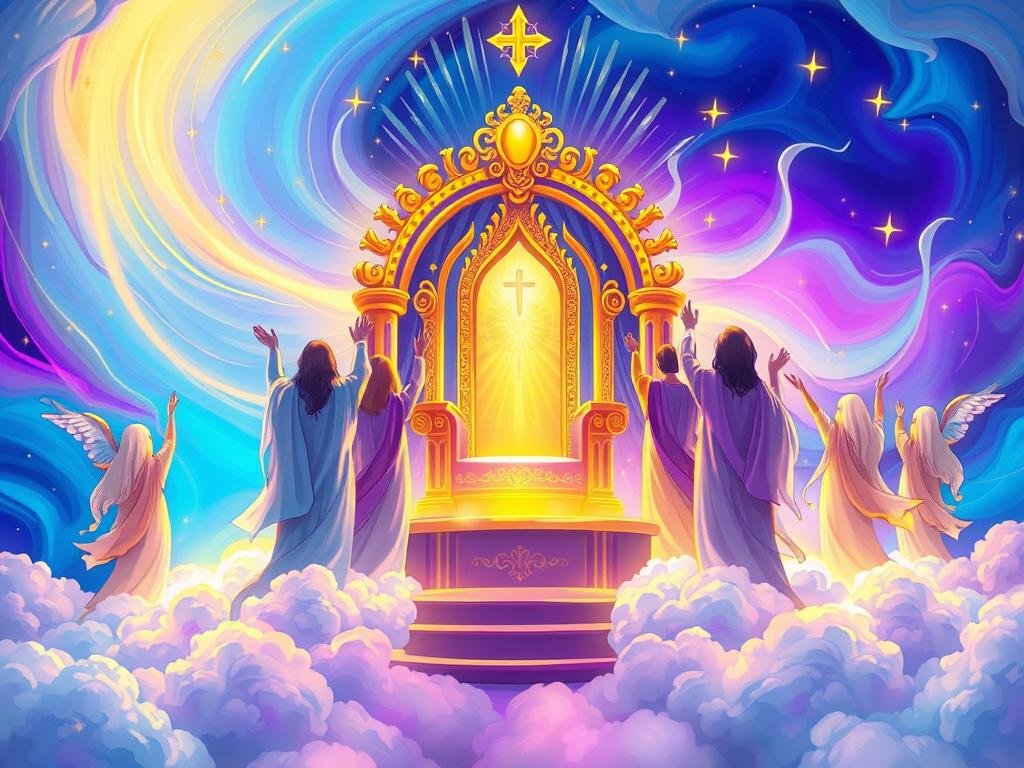
The Vision of the Heavenly Throne
In the Book of Revelation, John sees the heavenly throne. It is a moment of great worship. God reveals His majesty.
The term “throne” appears 47 times in 17 of the 22 chapters. This shows the importance of God's throne. 76,6% In these instances, he is directly linked to the throne of God.
In Chapter 5, the scene is striking. It shows God's sovereignty. The throne is surrounded by 24 elders e four creatures like cherubs.
O Lamb, who is the glorified Christ, is at the center. He represents sacrifice, but also victory. His seven horns and seven eyes They symbolize his power and knowledge.
“And I saw, in the midst of the throne and the four living creatures and the elders, a Lamb that looked as though it had been slain, with seven horns and seven eyes, which are the seven spirits of God sent out into all the earth.” (Revelation 5:6)
The vision of the heavenly throne reminds us of God’s sovereignty. It shows Christ’s victory. This scene calls us to celebrate the heavenly worship.
The Seven Seals and Their Meaning
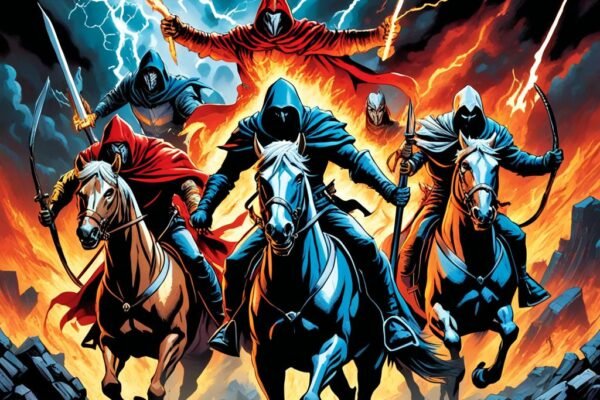
The seven seals of the Book of Revelation show divine judgments on land. These include the four horsemen of the Apocalypse, which symbolize conquest, war, famine, and death.
The opening of the seals brings about prophetic events that affect the world, leading to a great tribulation. And it all ends with Christ's triumphant return.
The Sequence of Prophetic Events
Each seal, broken by the Lamb (Jesus Christ) brings about significant changes. The first seal shows a white horseman, symbolizing conquest.
The second, riding a red horse, represents war. The third, riding a black horse, symbolizes famine.
And the fourth, riding a yellow horse, brings death, killing a quarter of the population.
The Global Impact of Stamps
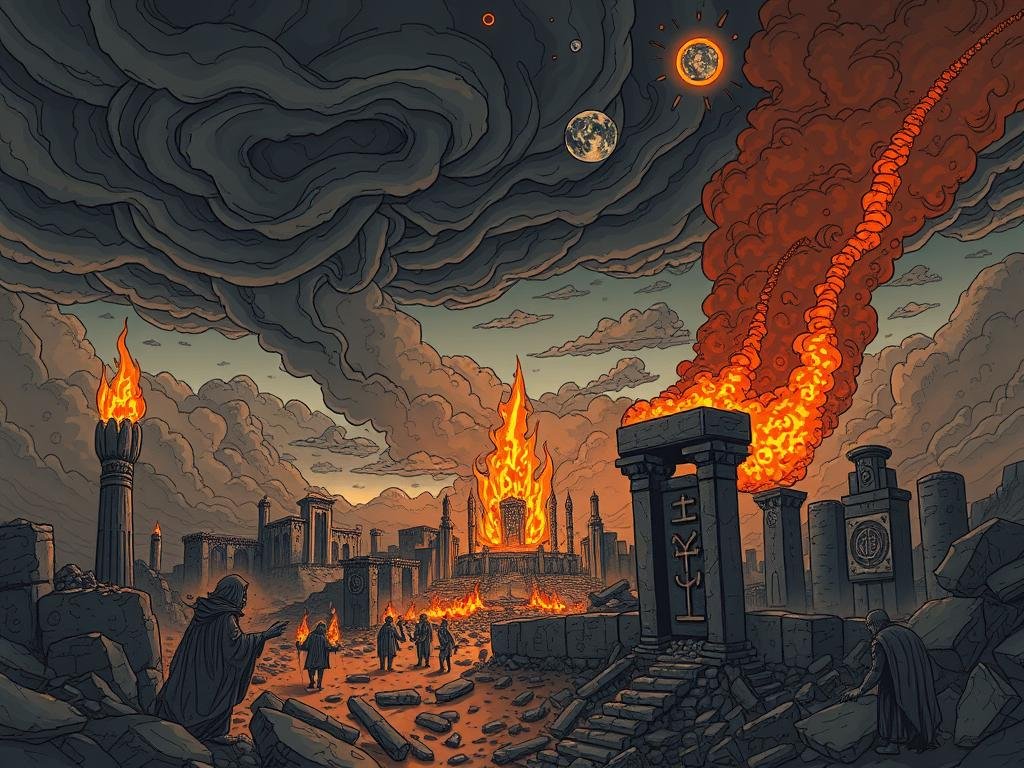
The opening of the seven seals brings terrible consequences to the world. There are cosmic disturbances, such as the sun being darkened and the moon turning red.
And the death of a quarter of the population due to divine judgments.
This apocalyptic scenario inspires terror and despair. But it also brings hope to the faithful. They will be rewarded for their faithfulness in the face of horsemen of the apocalypse.
The opening of the seventh seal is a dramatic moment. It heralds the Seven Trumpets, part of God’s plan to purify the earth and establish His eternal Kingdom.
The Seven Seals of Revelation reveal God's sovereignty and the importance of Christ. They highlight divine justice and mercy.
They call on believers to prepare themselves and wait for the triumphant return of our Savior.
The Drama of the Great Conflict
The Book of Revelation depicts a great spiritual battle between good and evil. God, Christ, angels, Satan, and his followers are involved.
The book describes how this struggle plays out on earth, with persecution, wars, and disasters. But it all ends with God’s victory over evil.
The Scriptures use the word “pólemos” (war) 18 times in the New Testament. Half of those occurrences are in Revelation. The verb “poleméu” appears 7 times, almost exclusively in Revelation.
The “drákon” (dragon) in the New Testament always refers to the devil. This shows the importance of the spiritual battle in the Apocalypse.
Miguel, the archangel, is an important figure in this struggle. In the Book of Daniel, he is called a “prince” and an “archangel.” According to the Adventist Bible Commentary, he symbolizes Jesus Christ.
“Then there was a great battle in heaven: Michael and his angels fought against the dragon. The dragon and his angels also fought, but they did not prevail, and there was no longer any place for them in heaven.” (Revelation 12:7–8)
Thus, the Book of Revelation depicts the struggle between good and evil. It highlights God’s victory over evil. This message of hope helps those who seek to understand God’s purpose amid the world’s conflicts.
The Beasts and Their Powers
The Book of Revelation speaks of mysterious beasts. They symbolize political and religious powers that oppose God. Two of these beasts are the Antichrist and false prophet.
Identifying Prophetic Symbols
The symbolic beasts have their roots in the Book of Daniel. He foretold world empires, from Babylon to the Roman Empire.
These empires are represented by animals, such as the lion and the beast with ten horns.
These visions do not merely describe historical events. They also point to future oppressive powers. For example, the mark of the beast and the forced worship of an image of the beast.
The Historical Context of the Prophecies
Christians were persecuted in the Roman Empire. Rulers such as Caesar and Nero persecuted them. This persecution is symbolized by the beasts of the Book of Revelation.
These prophecies also speak of the future. They indicate that anti-God forces will rise again.
| Empire | Period | Symbol | Description |
|---|---|---|---|
| Babylon | 605–539 B.C. | Lion with two wings | The First World Empire: A Forecast |
| Fear-Persia | 538–331 B.C. | Bear with 3 ribs | The Second World Empire: A Prediction |
| Greece | 331–168 B.C. | Leopard with 4 wings and 4 heads | Predicted Third World Empire |
| Rome | 168 B.C. – 476 A.D. | A terrifying beast with 10 horns | The Fourth World Empire: A Prediction |
The visions in Revelation and Daniel reveal a pattern. World empires oppose God and His people. This culminates in the Antichrist, false prophet e mark of the beast.
These symbols challenge us to remain faithful to God—even in the face of powerful forces that seek to oppose Him.
The New Jerusalem and the Final Promises
The Book of Revelation shows the heavenly city, a New Jerusalem. It comes from heaven to earth. This image represents God’s eternal home with His people in a new creation.
There, the eternal life That will be the rule. The prophetic book contains many final promises. They include the absence of death, pain, and tears.
Furthermore, the relationship between God and humanity will be restored. The city is described as having streets of gold, walls of jasper, and gates of pearl. This reflects God’s glory and holiness.
“I saw a new heaven and a new earth, for the first heaven and the first earth had passed away.” (Revelation 21:1)
The river of the water of life flows from God’s throne. It symbolizes life and divine provision. The tree of life, with its twelve fruits, promises abundance and healing for the nations.
- A heavenly city represents God's ultimate victory over evil.
- A new creation holds out the promise of a world without suffering and sin.
- A eternal life Being with God is the ultimate destiny of the faithful.
These images from the Book of Revelation offer hope. They encourage us to keep the faith, even in difficult times. The New Jerusalem points to a glorious future. God will dwell with His people forever.
The Message of Hope for the Last Days
The Book of Revelation conveys a message of hope. It speaks of the Christ's second coming and the reward for the faithful. It also discusses the final judgment of the forces of evil.
This message encourages believers not to lose their faith. Even in the face of persecution, they know that God will prevail. They know that an eternal kingdom will be established.
The Book of Revelation shows that God is in control of human history. It also shows that Christ will triumph over evil. This message of hope is important for everyone today.
Summarize the message of hope in Revelation. Jesus promises to return to reward the faithful and to establish an eternal kingdom on earth.
Therefore, studying the Book of Revelation brings hope. Stay alert and prepared. The hope found in the Book of Revelation is your hope for the last days.
FAQ
What is the Book of Revelation?
It is a message of hope for persecuted Christians.
What is the historical context of the Book of Revelation?
Who wrote the Book of Revelation, and what was his perspective?
What are the main symbols and meanings in the Book of Revelation?
Natural elements represent spiritual and political concepts.
What are the main events and prophetic revelations in Revelation?
Who are the seven churches mentioned in Revelation?
What does the vision of God's throne in heaven represent?
What are the seven seals, and what do they represent?
The seals reveal events that impact the world, leading to increasing tribulation and the return of Christ.
What are the beasts mentioned in Revelation, and what do they represent?
How does the Book of Revelation end, and what is its final message?
Source links
- Revelation: The Mystery Revealed!
- Symbols and Images in the Book of Revelation
- How to understand the Apocalypse - Good Christian Institute
- Revelation: how does the Bible describe the end of the world?
- The Biblical Apocalypse: Divine Wrath Upon the Earth
- What are the seven seals of the apocalypse?
- What are the seven seals in the Book of Revelation?
- The Great Conflict in the Apocalypse