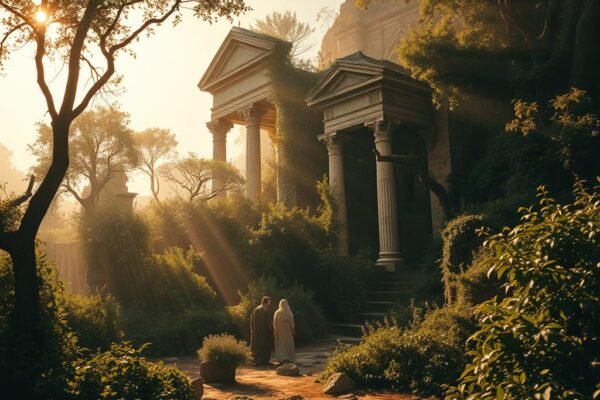
Human curiosity about paradise lost is as old as history itself. Among all the myths and legends that have permeated humanity's journey, the figure of The Garden of Eden stands out as one of the most fascinating and enduring enigmas.
But what exactly does this idyllic place, described as the cradle of life and innocence, represent and why does it continue to echo in our imagination? Get ready for a journey that transcends time and dogma, in search of the roots of this mystery.
Highlights
- The Garden of Eden is more than a physical location; it is a universal symbol of paradise and origin.
- Its exact location remains a mystery, with various religious and geographical theories.
- The Eden narrative has profoundly impacted cultures and religions, shaping concepts of sin and redemption.
- Exploring Eden invites us to reflect on human nature, the search for the sacred and nostalgia for an original state of harmony.
What is the Garden of Eden and what is its true meaning?
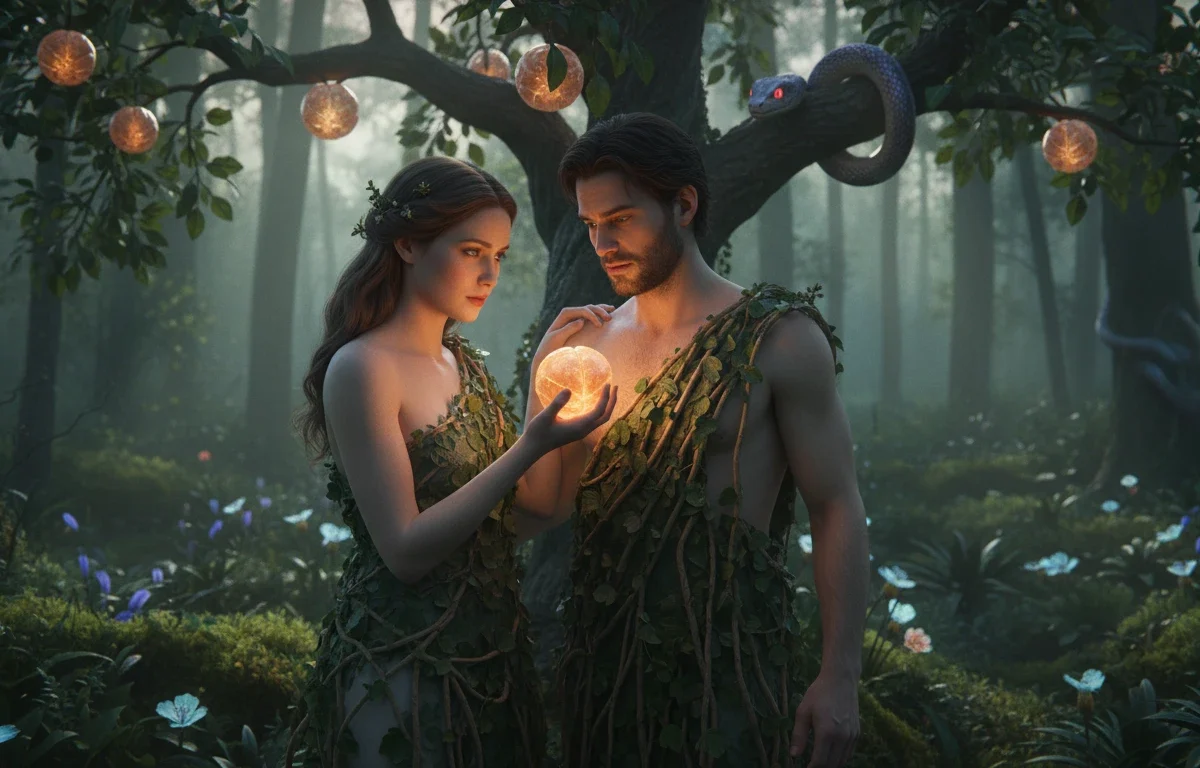
The Garden of Eden, as described in the Book of Genesis, is an earthly paradise created by God to house the first human beings, Adam and Eve. Symbolically, it represents a state of primordial innocence, abundance and perfect communion between humanity and the divine, serving as the cradle of civilization and the stage for the Fall of Man.
The Cradle of Humankind: Where History and Myth Meet
The Garden of Eden story is one of the cornerstones of Judeo-Christian theology, but its influence extends far beyond that. For many, it is the fundamental story about our origins, the loss of innocence and the awakening of conscience.
The Fascinating Details of Creation and Fall
Genesis 2 describes a place of incomparable beauty, watered by four mysterious rivers - Pison, Gihon, Tigris and Euphrates. At the heart of this garden, two trees stood out: the Tree of Life and the Tree of the Knowledge of Good and Evil.
The divine prohibition against eating the fruit of the latter was the supreme test for the newly created humanity.
Adam and Eve's disobedience, instigated by the serpent, led to their expulsion from Eden. This event, known as the Fall, is interpreted as the moment when humanity lost its immortality and its direct connection with God, introducing sin and suffering into the world.
The Relentless Search: Where Could the Lost Garden Be?
The idea of a lost physical paradise has fueled centuries of exploration and speculation. If Eden was a real place, where would it be located today? For a more in-depth look at theories about its location, see the Wikipedia on the Garden of Eden.
Geographical theories that challenge the imagination
Since ancient times, scholars and explorers have tried to map Eden. References to the Tigris and Euphrates rivers point to Mesopotamia, the region between the rivers that today comprises parts of Iraq, Syria and Turkey.
- MesopotamiaMany believe that the confluence of the Tigris and Euphrates rivers, perhaps near the Persian Gulf, is the most likely area. However, the other two rivers, Pisom and Gihon, remain unidentified with certainty.
- Armenia: Some theories point to the highlands of Armenia, where the Tigris and Euphrates rivers originate, and where there are also other large rivers that could be the ancient Pisom and Giom.
- Submerged Persian Gulf: A more recent hypothesis suggests that Eden could have been in a region that is now submerged by the Persian Gulf, before the post-Ice Age rise in sea levels.
These theories, while intriguing, face the challenge that geographies may have changed dramatically over millennia, especially after events such as the Flood, which many traditions also relate.
Beyond the Map: Eden as Metaphor
For many theologians and philosophers, the search for a physical location of Eden is secondary. They argue that the Garden is, above all, a powerful metaphor.
“The Garden of Eden is not just a place, but a state of being, a condition of harmony and innocence that humanity longs to recover.”
This perspective suggests that Eden represents an ideal of perfection, a reminder of what has been lost and what can be sought spiritually, a journey that is often addressed in religious studies and articles such as those by Live the Gospel.





The Undeniable Impact: How Eden Shaped Our Culture
The story of the Garden of Eden is one of the most influential founding myths of Western civilization, and its reverberations can be felt in almost every aspect of our culture.
From Original Sin to Redemption: A Spiritual Journey
The concept of “original sin”, derived from disobedience in Eden, is central to Christian doctrine. It explains the human inclination to evil and the need for salvation. This idea has been a driving force behind morality, ethics and the structuring of many societies.
- Art and Literature: From Michelangelo's Renaissance frescoes to John Milton's epics (“Paradise Lost”), Eden has been an inexhaustible source of inspiration. Its images of innocence, temptation and expulsion are universal.
- Music and Cinema: Numerous works explore the themes of Eden, whether as a paradise to be reached, a lost home or a setting for moral dilemmas.
- Everyday Language: Expressions such as “garden of Eden” to describe an idyllic place, or “apple of discord” (although the fruit is not specified in the Bible, The fact that the apple became the popular symbol of the forbidden fruit) shows how deeply the narrative has infiltrated our vocabulary.

What Do Other Traditions Say About an Original Paradise?
It's fascinating to note that the idea of an “original paradise” is not exclusive to the Judeo-Christian tradition. Many ancient cultures have similar narratives about a time of perfection and abundance that was lost.
Curious Parallels in Distant Myths
| Tradition | Original Paradise Name | Main Features |
|---|---|---|
| Sumer | Dilmun | Pure, clean, disease-free land; home of the gods. |
| Greek | Golden Age | Time without work or suffering; natural abundance. |
| Zoroastrianism | Airyanem Vaejah | A mythical land where life began, blessed by Ahura Mazda. |
| Hinduism | Satya Yuga (Golden Age) | A period of righteousness, virtue and universal harmony. |
These parallels suggest a universal human need to conceive of a perfect beginning, a time before the difficulties of the world, and the aspiration for a return to that state. For more information on creation.
Unraveling the Symbols: What is Eden Trying to Teach Us?
Far beyond a literal story, the Garden of Eden is rich in symbolism, offering profound lessons about human nature, freedom and the consequences of our choices.
The Tree of Knowledge: An Eternal Dilemma
The ban on eating from the Tree of the Knowledge of Good and Evil was not merely a divine whim. It represents the dilemma of freedom of choice and the responsibilities that come with it. By choosing knowledge, humanity has opened its eyes to the duality of the world, but also to the pain and suffering that accompany it.
- The SnakeOften seen as evil incarnate, the serpent can also be interpreted as temptation, the voice of doubt that challenges us to question the established rules.
- The Expulsion: Not just a punishment, but a necessary transition to maturity. By being expelled, man is forced to build his own path, to work and to face the realities of existence. It is the beginning of humanity's journey in search of its own redemption and meaning.

The Garden of Eden in the Modern Age: A Continuing Inspiration
Even in our secular and technological world, the image of Eden resonates. It speaks of a nostalgia for a simpler time, a deeper connection with nature and an endless search for a sense of home and purpose.
Recreating Paradise: From Gardens to Utopias
The influence of Eden can be seen in our desire to create spaces of beauty and tranquillity - from elaborate botanical gardens to the search for utopian communities. The idea of a “paradise on Earth” continues to drive environmental movements, which seek to restore harmony between humanity and the planet.
It's a reminder that although we may have been expelled from a primordial Eden, the ability to seek, create and value beauty and harmony remains intrinsic to the human experience.
Conclusion: The Garden of Eden: Mysteries and Legends of a Lost Paradise
The Garden of Eden transcends the boundaries of myth and history, remaining a powerful symbol in our collective consciousness. Whether interpreted as a lost physical place, a spiritual metaphor or a universal archetype, it invites us to reflect on our origins, the nature of freedom and the never-ending search for a state of harmony and purpose.
Its legend continues to inspire us to question, explore and, perhaps, recreate our own piece of paradise.
Frequently Asked Questions
The Garden of Eden is described mainly in chapters 2 and 3 of the Book of Genesis in the Old Testament of the Bible.
The Bible refers to it as the “Tree of the Knowledge of Good and Evil”. The fruit is not specified, although it is popularly associated with an apple.
Yes, the biblical narrative suggests that Adam and Eve would have had eternal life if they hadn't disobeyed. The Tree of Life, from which they were prevented from eating after the Fall, offered immortality.
There is no archaeological or geographical consensus on the exact location of the Garden of Eden. Theories point to Mesopotamia or other regions, but no definitive evidence has been found.
Yes, many ancient cultures have myths about an original paradise or a “Golden Age” that shares characteristics with the concept of the Garden of Eden, such as the Sumerian Dilmun or the Greek Golden Age.