
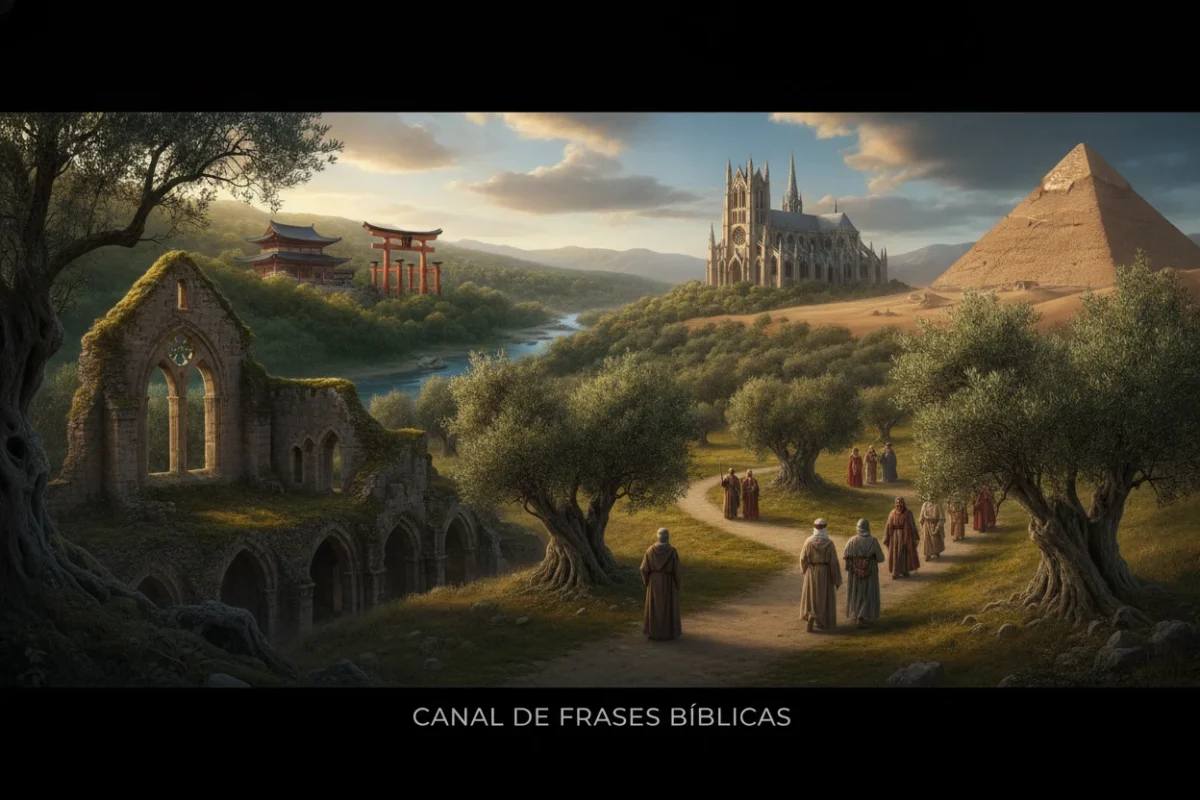
Did you know that most of the major decisions that have shaped our world today were driven by a deep spiritual motivation? Understanding the the connection between religion and history It helps us see how the Creator's hand has always guided our path throughout the ages.
When we look back at the past, we realize that our journey of faith is not isolated, but rather fully integrated into the events that have shaped modern society.
The connection between faith and the human journey
Often, when we study the past, we focus only on dates, battles, and prominent rulers.
However, humanity’s quest to understand the divine has always been the true driving force behind early social decisions.
In our pastoral work, we have observed in practice that people seek a meaning that transcends the physical world.
This spiritual quest shaped early laws, united distant tribes, and established the first concepts of morality that we know.
The connection between religion and history is revealed precisely in this intrinsic need to find a greater purpose for community life.
Without spirituality, ancient societies would not have had a clear guiding principle to govern justice and social coexistence.
Therefore, studying the connection between religion and history is, in fact, understanding the very essence of our journey on Earth.
Every step taken by our ancestors reflects a deep desire to walk in covenant with the promises from on high.
As we reflect on this journey, our own trust in God is strengthened in ways we cannot explain.
We realize that the connection between religion and history is not merely an academic coincidence, but a divine plan that is constantly unfolding.
The Connection Between Religion and History Explained
The history documented by the great civilizations and the accounts contained in the sacred scriptures do not run along opposing paths, but rather run parallel to one another.
Many modern archaeological discoveries confirm, with geographical and chronological precision, the events described by the Old Testament prophets.
Historical science often acknowledges the accuracy of biblical accounts of kings, battles, and the migrations of entire peoples.
This connection between religion and history validates our rational faith, showing that we do not follow fables that have been artificially created for emotional comfort.
“Remember the days of old; consider the years of many generations; ask your father, and he will tell you; ask your elders, and they will tell you.” (Deuteronomy 32:7)
This biblical passage invites us to look to the past in order to understand God’s faithfulness in the present.
The rich the connection between religion and history It becomes clear when we realize that every biblical prophecy is fulfilled in the real-world context of the nations.
Secular records merely bear witness to what the Holy Spirit had already foretold to His chosen servants.
The connection between religion and history shows us that God is not detached from events in the physical world.
He intervenes in the sovereignty of nations, moves the hearts of rulers, and writes His message of salvation into the timeline.
Great Empires and the Holy Scriptures
When we read about ancient Egypt or Babylon, we are dealing with powers that shaped the course of history of religions.
These empires were not merely political powers, but centers of intense spiritual and cultural activity that challenged the faith of the Hebrew people.
Archaeologists have discovered numerous clay tablets and monuments that mention kings of Israel and Judah exactly as described in the Bible.
These findings reinforce our conviction that the Holy Scriptures are historically reliable accounts inspired by God Himself.
The connection between religion and history becomes evident when we study the Babylonian captivity and the subsequent return decreed by Cyrus the Great.
The famous Cyrus Cylinder, preserved in a museum, confirms the Persian decree that allowed for the reconstruction of religious temples in antiquity.
This perfect parallel demonstrates that the connection between religion and history is an undeniable reality that underpins our Christian theology.
Empires rose, reached the pinnacle of the world, and fell, but the Word of the Lord has remained unshaken throughout the centuries.
We thus see the connection between religion and history as a living testimony that no human power can thwart God’s plans.



Three Milestones Where Faith Changed the Course of the World
God's involvement in human history has often taken the form of direct interventions that have forever altered the fate of nations.
In our theological studies, we have examined how moments of extreme crisis served as the perfect setting for extraordinary manifestations of the Creator’s power.
Below, we list three significant moments when faith profoundly transformed the course of entire peoples:
- The Exodus from Egypt: This historic event freed an enslaved people and shaped Israel’s moral, social, and spiritual identity under the tablets of God’s Law.
- The Fall of Jerusalem and the Exile: The period of trial in Babylon purified the people's faith and preserved the sacred scriptures for future generations throughout the world.
- The Apostles' Preaching in the Roman Empire: The message of salvation in Christ challenged the greatest military power of the time and transformed the ethical foundation of the entire Western civilization.
These historical milestones highlight the connection between religion and history, showing that faith has never been a purely individual experience.
It has always had enough power to break down cultural barriers, reshape empires, and guide humanity's moral progress.
The connection between religion and history teaches us that, in the darkest moments, God raises up men and women filled with the Holy Spirit.
Understanding this dynamic helps us grasp, for example, How Evangelical Churches Came to Be throughout the process of restoring sound doctrine.
The connection between religion and history is the common thread that unites us with the heroes of the faith from the past.
How This Journey Enriches Your Life Today
You may be wondering how these ancient and distant events can make any practical difference in your daily life.
The answer is simple: the same God who sustained kings, prophets, and martyrs in the past is the God who cares for you now.
If He was powerful enough to guide people through deserts and stormy seas, He is perfectly capable of guiding your financial, family, and emotional life.
The connection between religion and history serves as an anchor of hope in these times of anxiety, doubt, and distress.
When we look back and contemplate the Creator’s faithfulness, our fear of tomorrow loses all its power within us.
We understand that our personal story is also being written by the loving hands of a Father who never fails.
The connection between religion and history assures us that no crisis is too great for the One who rules the entire universe.
Rest your heart in the certainty that your earthly journey is part of an eternal plan of love, redemption, and spiritual victory.
The connection between religion and history reminds us that the Lord is in control of every detail, sustaining our spirituality every day.
Add your name to our prayer chain
The wonderful the connection between religion and history It proves to us that prayer is the most powerful tool for moving God's heart and changing impossible circumstances.
We’d like to invite you to be part of this wonderful story of miracles and daily provision that the Lord has prepared for our lives.
Please leave your first name in the comments below so that our team at the Biblical Verses Channel can intercede for you and your family in our prayer chain.
Take this opportunity to bless the life of someone special today by sharing the link to this article on WhatsApp with a friend or family member who needs a boost.
If you'd like to continue delving deeper into the stories of faith that shaped the scriptures, find out Who was the prophet Elijah? and see how his legacy of courage continues to inspire thousands of Christians around the world.
Frequently Asked Questions About the Connection Between Religion and History
How can we define, in practice, the connection between religion and history?
It is defined as the profound mutual influence between the human spiritual quest and the events that have shaped society. Faith is not isolated from the past, but rather the true driving force that shaped the earliest laws, united distant tribes, and established the primitive concepts of morality and communal justice.
How can we use historical accounts to strengthen our personal faith in our daily lives?
You can do this by studying modern archaeological discoveries that confirm biblical accounts. By analyzing the geographical and chronological accuracy of events described by prophets, you can rationally validate your faith, realizing that human history reflects a divine plan that has been unfolding throughout the ages.
What are the benefits for Christians of understanding the connection between religion and history?
The main benefit is the inexplicable strengthening of our trust in God as we realize that the course of human history is not a mere academic coincidence. Understanding this connection brings spiritual clarity, showing that every biblical prophecy is fulfilled in the real-world context of nations and that the Creator has always guided our journey.
What is the difference between the secular view and the providentialist view of humanity's past?
The secular perspective focuses solely on cold, hard data, battles, and prominent rulers as purely human factors. The providentialist perspective, on the other hand, sees the connection between religion and history, understanding that the search for the divine and God’s sovereignty are the true driving forces behind the decisions that have shaped the world as we know it today.
Is it a myth that historical science and the accounts in the sacred scriptures are contradictory?
Yes, it is a myth. Documented history and the sacred scriptures run parallel to one another, and historical science itself often acknowledges the accuracy of the biblical accounts of kings and migrations. Modern discoveries confirm that secular records merely bear witness to what the Holy Spirit had already foretold.


