

In 1 Samuel, we find important records regarding the origin of the Kingdom of Israel. The book recounts the battles epic, the prophecies and the anointings that anointed leaders such as Saul e David. In this article, “The Birth of a Kingdom,” we’ll explore the key events and details of this fascinating story.
The Early Stages of the Kingdom of Israel
The book of 1 Samuel covers the early stages of the Kingdom of Israel. In it, we see the story of the prophet Samuel, who was called by God to be a key leader in the transition from a theocratic government to a monarchy. Samuel announces the downfall of the priest Eli and the selection of Saul as the first king of Israel. The anointing of Saul and the prophecies related to his reign are detailed in this book.
Samuel, a central character in 1 Samuel, plays a crucial role in the history of the Kingdom of Israel. He was a faithful prophet who obeyed God, chosen to lead the nation and convey God’s will to the people.
Throughout his journey, Samuel foretells the downfall of the priest Eli and his two daughters, prophesying the collapse of the priestly lineage and the end of Eli’s rule over Israel. The prophecy It is fulfilled when Eli and his descendants die tragically, paving the way for significant changes in Israel's future.
After Eli's death, Samuel is instructed by God to anoint Saul as the first king of Israel. This anointing It was an important event, as it symbolized God's choice of Saul and the authority bestowed upon him to lead the people of Israel.
“Then Samuel left Ramah and went to Saul.” – 1 Samuel 10:1
The prophecies concerning Saul's reign are also detailed in 1 Samuel. Samuel predicted that Saul would be a powerful and successful leader, but warned of the consequences of his disobedience to God.
The Book of 1 Samuel depicts the early stages of the Kingdom of Israel with a wealth of detail and historical depth. Through the words of the prophet Samuel, we can visualize the events that shaped the destiny of the people of Israel during their transition to a monarchy and understand the importance of the anointing and the prophecies in the context of the reign.
The Reign of Saul and the Rise of David
1 Samuel also recounts the reign of Saul and the rise of David to the throne of Israel. Saul, despite having been anointed by Samuel, ends up displeasing God and losing His favor. Meanwhile, David, a young shepherd, is chosen by God to be the next king.
The book describes the battles David's battle against Goliath, his flight from Saul and Saul's pursuit of him, and his eventual coronation as king of Israel.
The Prophecies and the Anointing of the Kings in 1 Samuel
Prophecies and the anointing of kings are key elements in 1 Samuel. Throughout the book, we see how Samuel’s prophecies are fulfilled, both regarding Saul’s rise to power and David’s future lineage. Furthermore, Samuel’s anointing of the kings is a significant event that symbolizes divine choice and the authority bestowed upon each leader.
Prophecies play a crucial role in the story told in 1 Samuel. Samuel, as a prophet and judge, received messages from God concerning the future kings of Israel. These prophecies not only foretold Saul’s rise to power, but also pointed to the future line of David, which would be blessed and established as an eternal royal line.
These prophecies were fulfilled just as Samuel had said. Saul was chosen as the first king of Israel, for it was God’s will that Israel have a human ruler. However, because of his disobedience and lack of humility, Saul lost God’s favor, and the prophecy about the line of David began to take shape.
The anointing of kings is also an important aspect of 1 Samuel. Through the anointing, Samuel consecrated and authorized the leaders chosen by God to govern the people of Israel. By anointing Saul and, later, David, Samuel conferred divine authority, establishing these leaders as God’s representatives and the legitimate rulers of the kingdom.
The image below depicts a key moment in 1 Samuel, when Samuel anoints David as king:
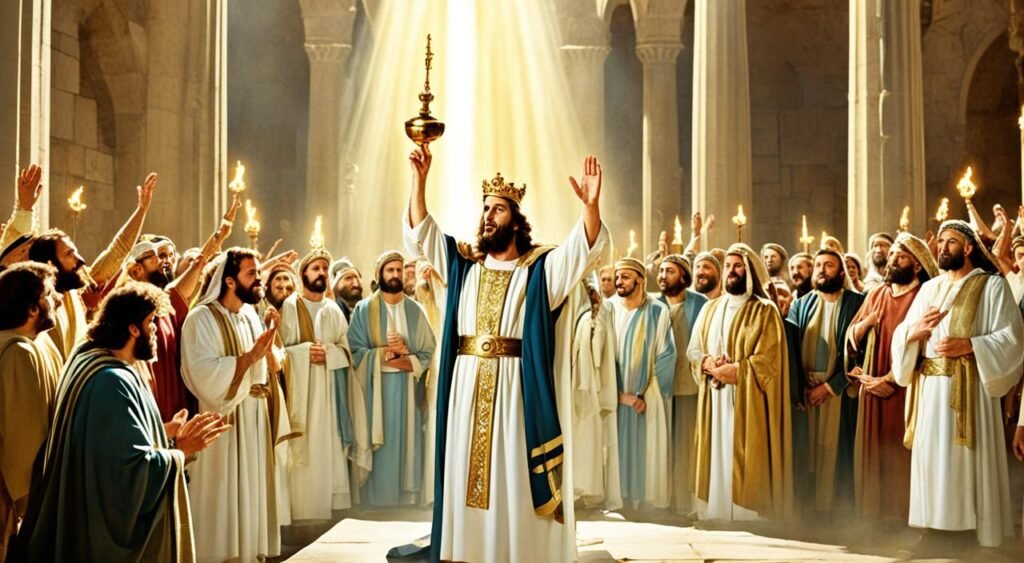
This anointing was a milestone in the history of Israel, as it marked the beginning of David’s reign—a leader anointed by God and destined to establish a strong royal dynasty. Through the prophecies and anointings in 1 Samuel, we see God’s hand at work in the selection and establishment of kings, demonstrating the fulfillment of His promises and the supernatural guidance that shaped Israel’s destiny.



The Epic Battles in 1 Samuel
1 Samuel is full of battles epic events that shaped the destiny of the Kingdom of Israel. From the early wars led by Saul to David’s battles against Israel’s enemies, the book provides an overview of the battles and military strategies of this historical period. These battles are essential to understanding the context in which the kingdom developed.
Right at the beginning of the book, we find the story of the battle between the Philistines and the Israelites. The outcome of that battle—with the death of the priest Eli and the capture of the Ark of the Covenant by the Philistines—marks a crucial moment in the narrative.
Another notable battle is fought by the young David when he accepts the challenge from Goliath, the Philistine giant. With courage and faith With God's help, David defeats the enemy and becomes a hero in Israel.
In addition, 1 Samuel also describes the battles and persecutions David faced while fleeing from King Saul. These confrontations highlight David’s bravery and strategic intelligence, as he proved himself to be a courageous and respected leader.
These battles, recounted in 1 Samuel, show how the Kingdom of Israel was forged amid challenges, struggles, and victories. They also illustrate the importance of courageous and determined leaders in building a prosperous and secure kingdom.
David's Battle Against Goliath
“You come against me with sword, spear, and shield, but I come against you in the name of the Lord of Hosts, the God of the armies of Israel, whom you have defied… Today the Lord will deliver you into my hands, and I will kill you and cut off your head. Today I will give the bodies of the Philistine soldiers to the birds of the air and the wild animals, and the whole earth will know that there is a God in Israel.” – David, 1 Samuel 17:45–46 (NIV)
The famous battle between David and Goliath is an inspiring example of faith, courage, and trust in God. It illustrates how biblical heroes faced seemingly impossible challenges, relying on divine power to achieve victory.
| Battles | Leaders |
|---|---|
| Battle Against the Philistines | Saul |
| David's Battle Against Goliath | David |
| Battles During Saul's Pursuit of David | David |
The battles and military conflicts described in 1 Samuel are crucial to our understanding of the historical context and the development of the Kingdom of Israel. Furthermore, they remind us that, even in the face of the greatest adversities, faith in God and courage can lead us to victory.
Conclusion
In summary, the book by Samuel It is a rich source of information about the origins of the Kingdom of Israel. As we follow the prophecies and anointings of the leaders, the epic battles, and the events that led to the formation and consolidation of the kingdom, we are drawn into a fascinating story. The stories involving Samuel, Saul, and David not only entertain us but also teach us important lessons about leadership, obedience to God, and the significance of divine purpose in human history.
The book of 1 Samuel shows us how God works in the lives of individuals and in the building of nations. We can follow Samuel’s journey, from his calling by God to the establishment of the monarchy in Israel. Saul, the first king, reveals how disobedience and a lack of trust in God can lead to downfall and the loss of divine favor. David, on the other hand—the king after God’s own heart—exemplifies the importance of faith, courage, and dependence on God in facing great challenges and achieving victory.
Through the pages of 1 Samuel, we can explore the complex nature of human beings and the moral dilemmas faced by leaders. The stories of Samuel, Saul, and David are full of ups and downs, victories and defeats, but also of forgiveness, regret and restoration. These accounts provide us with valuable insights for our own journey, serving as inspiration for us to pursue a life of purpose, submission to God, and transformative leadership.
Want more inspiring and informative content? Continue your journey of learning and discovery on our blogwhere you'll find a variety of articles to enrich your mind and soul. Explore now and dive into an ocean of knowledge and inspiration!
FAQ
Q: What is the main theme of the Book of 1 Samuel?
A: The Book of 1 Samuel explores the origins of the Kingdom of Israel, recounting the battles, prophecies, and anointings that took place during that period.
Q: Who was Samuel, and what was his role in the history of Israel?
A: Samuel was an important prophet and leader during Israel’s transition from a theocratic government to a monarchy. He was called by God and was responsible for anointing and prophesying about Kings Saul and David.
Q: What is the anointing of the kings in 1 Samuel?
A: The anointing of the kings in 1 Samuel is a significant event in which the prophet Samuel pours oil on those chosen by God to be the leaders of Israel. This anointing symbolizes divine choice and the authority bestowed upon each of these kings.
Q: What is the significance of the prophecies in 1 Samuel?
A: The prophecies in 1 Samuel play a crucial role in the story, as they foretold future events and were fulfilled throughout the book. They revealed Saul’s rise as the first king of Israel and the future line of David as king.
Q: What are the epic battles mentioned in 1 Samuel?
A: 1 Samuel describes several battles that shaped the fate of the Kingdom of Israel. These include the early wars led by Saul and David’s battles against Goliath and other enemies of Israel.
Q: What can we learn from the story of Samuel, Saul, and David in 1 Samuel?
A: The story of Samuel, Saul, and David in 1 Samuel teaches us valuable lessons about leadership, obedience to God, and the importance of divine purpose in human history. We can learn about God’s choice of leaders and the challenges they face as they follow God’s path.