Learn about the Tower of Babel: If you've ever heard of the Tower of Babel, you've probably wondered about its origin and meaning. This myth has its roots in the book of Genesis, in the Bible, and carries with it a powerful narrative about the confusion of tongues, a disobedience to God, o human pride and divine punishment.
Let's explore this fascinating story and discover what it can teach us about human diversity and the communication challenges. Get ready for a journey full of discoveries and deep reflections.
The Tower of Babel in the Bible
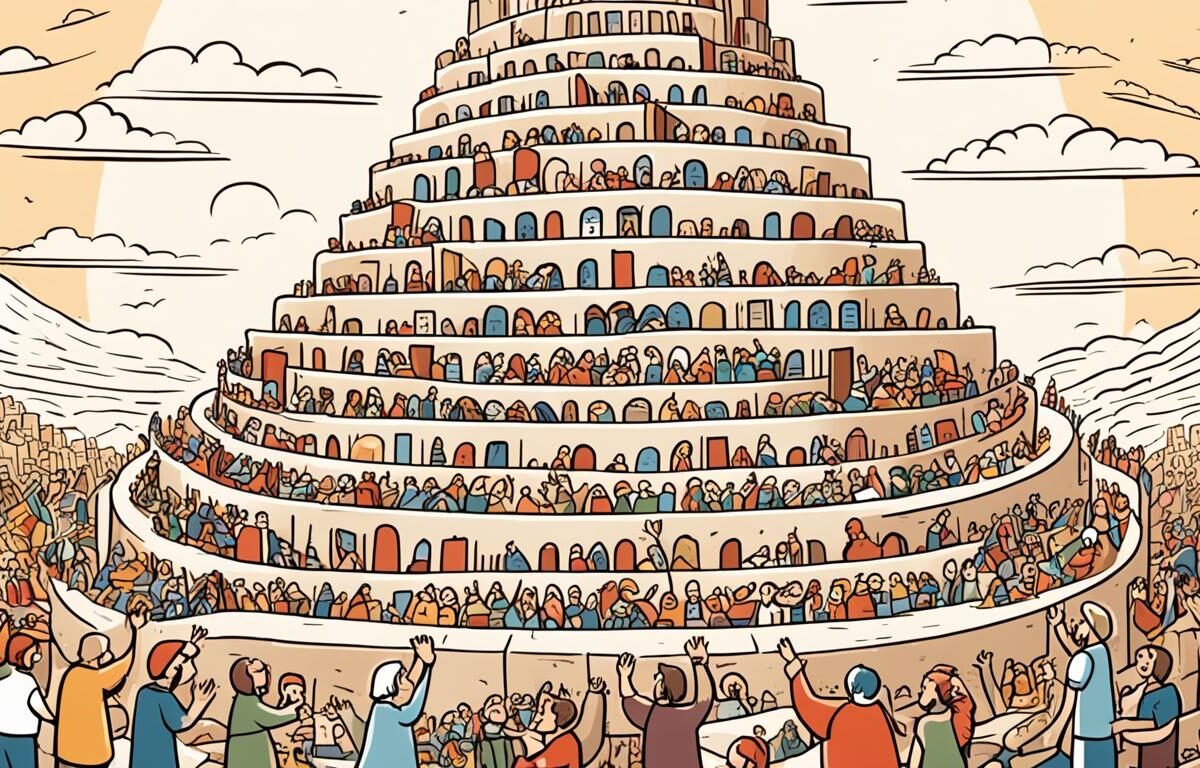
The myth of Tower of Babel is found in the book of Genesis, chapter 11, verses 1–9. The story recounts how humans built a tower in order to reach the heavens and prevent humanity from being scattered.
However, God intervened, bringing about the confusion of tongues and forcing human beings to disperse as a punishment for their disobedience.
History tells us that, at that time, all peoples spoke a single language and used the same words.
Driven by ambition and disobedience to GodWhen the city was built, human beings decided to build a tower that would reach the heavens, as a symbol of their pride and open defiance of God. But God, in his divine omnipresence, came down to see the city and the tower that men were building.
"Then the Lord said, 'Behold, the people are one, and they all have the same language. This is only the beginning; now there will be no restriction on anything they try to do. Let us go down and confuse their language, so that one cannot understand what the other says."
Genesis 11:6-7
God, in His divine wisdom, decided to confuse the languages of human beings so that they would no longer understand one another.
This divine punishment resulted in humanity being scattered across the Earth, with each group speaking its own language and unable to communicate effectively with one another. The Tower of Babel thus became the symbol of disobedience to God and divine punishment.
| Building the tower | Divine punishment | Disobedience to God |
|---|---|---|
| Humans have built a tower to reach the heavens | God confused the languages and scattered mankind across the earth | They obeyed their ambition, defying God's will |
The Tower of Babel as a founding myth
The Tower of Babel is considered a founding myth, as it seeks to explain the origin of linguistic diversity and the dispersal of human beings across the Earth.
It symbolizes the division among peoples and the fragmentation of humanity. In addition, the myth also addresses issues related to faith and tradition, highlighting the importance of following divine plans.
According to the biblical narrative, the construction of the Tower of Babel represented the unbridled ambition of human beings in defying God's plans.
The peoples of that time sought unity and greatness, but they disobeyed God’s commands. As punishment, God confused their languages and scattered them across the Earth.
This myth is a powerful division symbol among peoples and the fragmentation of humanity. It highlights the difficulty that different cultures have in communicating with and understanding one another.
The Tower invites us to reflect on the challenges of living in a diverse world, where communication isn't always easy.
In addition, the story of the Tower also raises questions about the importance of faith and tradition in human life. It makes us reflect on divine plans and the importance of following religious principles in order to achieve unity and avoid conflict.
"The Tower of Babel is a powerful reminder that the linguistic diversity and cultural diversity is a fundamental part of the human experience. We must seek unity by respecting diversity and by intercultural dialog.” – João Silva, Bible scholar.
The Tower of Babel invites us to reflect on the importance of valuing the cultural diversity and seek harmony between peoples.
It teaches us the importance of overcoming communication barriers and seeking mutual understanding. Through this ancient story, we are invited to reflect on how to build a more tolerant and respectful world, where faith and tradition can coexist in harmony.

| Unity Versus Fragmentation | Faith and Tradition |
|---|---|
| The Tower of Babel symbolizes the fragmentation of humanity, showing how division between peoples can lead to conflict and misunderstanding. | The myth addresses issues related to the importance of following divine plans, highlighting the role of faith and tradition in human life. |
| We can overcome fragmentation by seeking unity through respecting diversity and intercultural dialog. | Through the Tower of Babel, we are encouraged to value the cultural diversity and seek harmony between peoples. |
The Tower of Babel is a symbol of the division between peoples, but it also reminds us of the importance of unity, respect for diversity and the search for harmonious coexistence.
Tower of Babel in history and archaeology
Although the story of the Tower of Babel is considered a myth, archaeology has revealed evidence of similar constructions in Mesopotamia, such as the ziggurats. It is believed that the Etemenanki, a ziggurat built in Babylon, may have corresponded to the Tower of Babel.
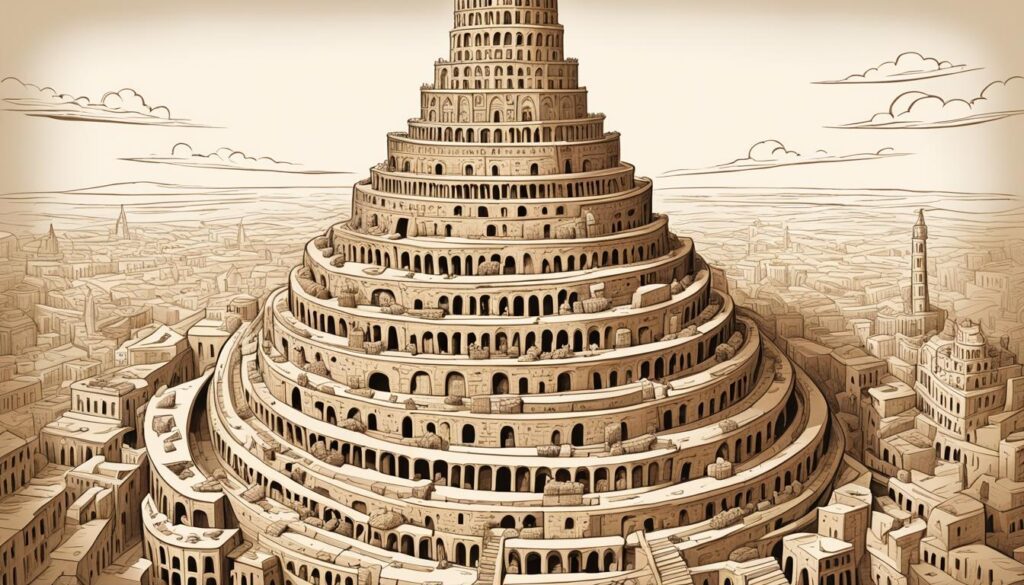
Archaeological sites have been discovered in the region of ancient Babylon, where ruins and artifacts show the presence of these buildings and their importance in Mesopotamian culture.
One site that has been attributed to possible remains of the Tower is the archaeological site from the ruins of Babylon, located in present-day Iraq.
These ruins offer a fascinating glimpse into the ancient city of Babylon, which rose to fame and wealth during the reign of the legendary King Nebuchadnezzar II.
These archaeological excavations have played an important role in the study of the mythology, legends and tales of the Tower of Babel, as well as in understanding the biblical archaeology and ancient Mesopotamian culture.
Main archaeological discoveries related to the Tower of Babel
| Location | Uncovered remains |
|---|---|
| Site of the Ruins of Babylon | Ziggurats and other remains of the ancient city of Babylon |
| Site of Uruk | Archaeological objects that refer to Babylonian legends, including representations of the Tower of Babel |
| Ur site | Clay tablets with cuneiform writing that refer to stories related to Babylon and its monumental buildings |
"Archaeological excavations in the ruins of Babylon have revealed valuable treasures from the past, helping us to reconstruct the history of the Tower of Babel and to understand the architectural and cultural achievements of the Mesopotamian people." - Renowned biblical archaeologist
Archaeological research continues, providing more and more interesting information about the Tower of Babel and Mesopotamian culture. These discoveries help connect the mythology with historical reality, enriching our understanding of these ancient legends and tales.



The Tower of Babel as a cultural and artistic symbol
The Tower of Babel transcended its biblical narrative and became a powerful symbol in literature, art and cultural representations throughout history. Its impact is evident in various literary works and artistic manifestations, testifying to its lasting influence on human culture.
In literature, the Tower of Babel features prominently in landmark works. In the epic poem "Aeneid", written by Virgil, the tower is cited as a symbol of human arrogance and the unbridled ambition.
In A.S. Byatt’s novel *Babel Tower*, the Tower of Babel is used as a metaphor to explore the complexities of human relationships and the communication challenges.
In addition to literature, the Tower of Babel is also depicted in the visual arts. Over the centuries, numerous artists have portrayed the tower in paintings, sculptures, and prints.
These artistic depictions underscore the tower's historical and symbolic importance, as well as its influence on culture and the collective imagination.
"The Tower of Babel, with all its symbolic charge, continues to fascinate and inspire us creatively in the most diverse forms of artistic expression, making us reflect on our humanity and the issues that surround us." - Artur Silva, art critic
The Tower of Babel as a cultural and artistic symbol also reflects the human fascination with the linguistic diversityIt reminds us of the challenges and opportunities inherent in communication between different cultures and languages. It reminds us of the challenges and opportunities inherent in communication between different cultures and languages.
Below are some notable literary works and artistic representations that explore the Tower of Babel:
Literary works:
- “Aeneid“ - Virgil
- “Babel Tower“ - A.S. Byatt
- “Babel-17“ – Samuel R. Delany
"These literary works offer a unique vision of the Tower of Babel, exploring the complexity of human relationships and the challenges of communication in a world of cultural diversity." - Julia Santos, literary critic
Artistic Representations:
- Painting: "The Tower of Babel" - Pieter Bruegel the Elder
- Sculpture: "Tower of Babel" - Maurits Cornelis Escher
- Print: "Tower of Babel" - Carolus Verhaeren
These visually striking works of art invite us to contemplate the greatness and symbolic meaning of the Tower of Babel.
The Tower of Babel as a cultural and artistic symbol bears witness to its cross-cultural relevance over time, continuing to spark our inspiration and reflection on the human condition, linguistic diversity and the challenges of communication in an increasingly interconnected society.
The Tower of Babel as a metaphor
The Tower of Babel is also often used as a metaphor to represent the unbridled ambition and the dangers of arrogance human.
It serves as a reminder that the pursuit of power and greatness can lead to a person's downfall. This metaphor has been explored in various contexts, such as politics, business, and even psychology.
"The Tower of Babel is a powerful metaphor for the unbridled ambition of man. It warns us of the dangers of arrogance and reminds us that the relentless pursuit of power can result in tragic consequences." - John Smith, renowned author.
In politics, the Tower of Babel is seen as a symbol of the negative consequences of the unbridled ambition of leaders who seek only their own power, putting the stability and well-being of society as a whole at risk. In business, the Tower of Babel metaphor is often used to warn about the risks of rapid and uncontrolled growth, emphasizing the importance of sustainable and balanced growth.
In psychology, the Tower of Babel is explored as an example of how unbridled ambition can lead to frustration and a lack of personal fulfillment. It's a reminder that it's important to set realistic goals and strive for excellence in a healthy way, avoiding the dangers of arrogance.
In short, the Tower of Babel as a metaphor invites us to reflect on the importance of balancing our ambitions and avoiding actions driven by sheer arrogance. It reminds us that the quest for power and greatness must be aligned with ethical principles and responsibility, so that we can build a more balanced and harmonious society.
Tower of Babel and linguistic diversity
The Tower of Babel is a symbol of the linguistic diversity that exists between peoples. A confusion of tongues The confusion caused by God in the biblical narrative reflects the communication difficulties and misunderstandings that arise due to linguistic diversity.
The story of the Tower of Babel invites us to reflect on the importance of communication and respect for linguistic and cultural diversity.
Linguistic diversity is a fascinating phenomenon that enriches our society. Through it, each culture expresses itself, shares its knowledge and beliefs, and builds a unique identity.
However, this diversity can also create communication barriers and misunderstandings among people.
Throughout history, linguistic diversity has been a source of conflict and challenges. A lack of mutual understanding can lead to misunderstandings, prejudice, and even conflict between different linguistic groups.
The Tower of Babel reminds us of these challenges and inspires us to seek solutions that promote communication and understanding among different languages and cultures.
In order to overcome the difficulties of linguistic diversity, it is essential to value the importance of each language and to strengthen the intercultural dialog.
Effective communication requires not only language skills, but also empathy and respect for cultural differences.
We should strive to learn about other languages and cultures, promote inclusion, and ensure that everyone has the opportunity to express themselves and be understood.
Only when we recognize linguistic diversity as a source of richness and seek unity in diversity can we build a more inclusive, just, and harmonious society.
The Tower of Babel teaches us that communication and mutual respect are essential for overcoming language barriers and building bridges between people.
"The diversity of languages is one of the most beautiful expressions of humanity's cultural wealth" - [Author]
Therefore, as we reflect on the Tower of Babel, we are invited to celebrate linguistic diversity, promote unity in diversity, and seek mutual understanding in an increasingly globalized world.
Only in this way can we build a more inclusive future, where everyone’s voice is heard and valued, regardless of their language or culture.

| Benefits of linguistic diversity | Challenges of linguistic diversity |
|---|---|
|
|
Tower of Babel and globalization
The Tower of Babel can also be interpreted in the light of the challenges of globalization. As migration and the flow of information and culture among peoples intensify, there arises a need to address cultural diversity and the challenges of communication in an increasingly interconnected world.
The Tower of Babel makes us reflect on the search by unit and intercultural dialog as ways to build a more tolerant and respectful society.
Lessons from the Tower of Babel for the modern world
The story of the Tower of Babel offers important lessons for the modern world. It makes us reflect on the challenges of globalizationthe need for search by unit in the midst of diversity, the importance of intercultural dialog and of tolerance and respect the differences.
The Tower of Babel is a reminder that, despite language and cultural barriers, we are all human beings sharing the same planet. A search by unit involves overcoming these barriers and seeking to understand and appreciate the perspectives and experiences of others.
Intercultural dialogue plays a crucial role in this process. By opening ourselves up to listening to and learning from different cultures, we can build bridges of understanding and strengthen the bonds between people.
The exchange of ideas and knowledge promotes diversity and enriches society as a whole.
"True wisdom comes when we are willing to listen to the voices of those who are different from us and recognize the value of their perspectives."
Furthermore, tolerance and respect are fundamental to building a fairer and more inclusive society. We must learn to value and respect differences, recognizing that each individual has their own history, culture and worldview.
Therefore, the lessons of the Tower of Babel invite us to build a world where diversity is celebrated and where all people are treated with equality and respect. Only in this way can we face the challenges of globalization and create a more harmonious future for everyone.
Example Table: Challenges of Globalization
| Challenges | Description |
|---|---|
| Cultural Diversity | Integrating different cultures in a globalized world and respecting their traditions and values. |
| Communication | Overcoming language barriers and developing effective means of intercultural communication. |
| Tolerance and Respect | Promoting a culture of tolerance and respect the diversity of opinions, beliefs and lifestyles. |
| Unity in the midst of diversity | To seek unity and cooperation between different nations and peoples, despite their differences. |
| Intercultural Dialogue | Promoting dialog and the exchange of ideas between cultures to promote mutual understanding. |
New perspectives on the Tower of Babel
In recent decades, new perspectives have emerged in the study of the Tower of Babel. A historical linguistics has been investigating the origin of languages and the relationship between languages spoken today.
The bible studies have sparked new reflections on the story of the Tower of Babel, exploring different interpretations and cultural contexts.
In addition Mesopotamian archaeology has revealed new discoveries and research into Mesopotamian culture and its relationship with the story of the Tower of Babel.
When analyzing the origin of languages, a historical linguistics It seeks to understand how different languages have evolved over time and how they are related to one another.
This field of study examines both the similarities and differences between languages, using comparative methods and linguistic reconstructions to trace lines of descent and linguistic evolution.
In turn, the bible studies They offer in-depth interpretations and analyses of the Tower of Babel story found in the Bible.
These reflections broaden our understanding of the historical, cultural, and theological context in which the myth was written, revealing different layers of meaning and the possible religious and philosophical messages conveyed by this story.
“The Tower of Babel is a fascinating topic for Bible scholars, as it challenges us to explore fundamental questions about the relationship between God, humanity, and linguistic diversity.” – Dr. Pedro Silva, scholar of bible studies.
A Mesopotamian archaeology It has contributed to the study of the Tower of Babel by revealing new findings about Mesopotamian culture and its relationship to biblical history.
Through archaeological excavations in the region where ancient Babylon is believed to have stood, researchers have found evidence of structures similar to those described in the story of the Tower of Babel, such as ziggurats.
Example Table - Comparison of currently spoken languages:
| Language | Origin | Language Family |
|---|---|---|
| English | Germanic origin, influenced by Latin and Old French | Indo-European |
| Spanish | Latin origin, influence of Arabic and Native American languages | Romanesque |
| Mandarin | Origin in ancient China, evolution of archaic Chinese | Sino-Tibetan |
| Arabic | Origin in the Arabian peninsula, influence of other Semitic languages | Semitic |
These new perspectives have enriched the study of the Tower of Babel, expanding our understanding of the origin of languages, the connections between the Bible and Mesopotamian culture, and the different meanings and interpretations attributed to this ancient story.
These advances encourage us to continue exploring and questioning the Tower of Babel, seeking to unravel its mysteries and better understand human diversity and the origins of language.
Conclusion: Learn about the Tower of Babel
The story of the Tower of Babel has a symbolic meaning profound and teaches us important lessons about human diversity, communication and the challenges of globalization.
This founding myth invites us to reflect on the pursuit of unity, intercultural dialogue, tolerance, and respect for differences.
The Tower of Babel represents the struggle between the search for unity and the diversity that permeates humanity. It alerts us to the importance of dialog and cultural integration in the modern world, where the globalization and migration make these challenges ever more present.
We can learn important lessons from the Tower of Babel to build a more inclusive and just world. Valuing cultural diversity and seeking mutual understanding are essential for promoting tolerance and respect in relations between peoples.
The Tower of Babel invites us to recognize the importance of overcoming conflict and promoting integration, seeking unity amid diversity.
His lessons continue to resonate to this day, inspiring us to build a modern world that accepts and celebrates differences, while promoting intercultural dialogue and peace among nations.
FAQ
What is the Tower of Babel?
The Tower of Babel is a construction mentioned in a mythical narrative found in the book of Genesis in the Bible. It was used to explain the emergence of humanity's linguistic diversity and the dispersion of human beings across the Earth.
Where can I find the story of the Tower in the Bible?
The story of the Tower can be found in the book of Genesis, chapter 11, verses 1 to 9.
What is the origin of linguistic diversity according to the Tower narrative?
According to the Tower's narrative, linguistic diversity arose as a divine punishment for disobedience and human pride in the construction of the tower.
Is the Tower of Babel considered a founding myth?
Yes, the Tower of Babel is considered a founding myth, as it seeks to explain the origin of linguistic diversity and the dispersion of human beings for the Earth. It also addresses issues related to faith and tradition.
Is there any archaeological evidence of the Tower of Babel?
Although it is considered a myth, archaeology has revealed evidence of similar constructions in Mesopotamia, such as ziggurats, and archaeological sites in the region of ancient Babylon, where ruins and artifacts suggest the presence of these constructions.
Is the Tower of Babel mentioned in literary works?
Yes, the Tower of Babel appears in several works of literature, such as Virgil's epic poem "Aeneid" and A.S. Byatt's novel "Babel Tower".
What is the symbolic meaning of the Tower of Babel?
The Tower of Babel is often used as a metaphor to represent unbridled ambition and the dangers of human arrogance. It symbolizes the fall of man and serves as a reminder of the risks of the quest for power and greatness.
What is the relationship between the Tower and linguistic diversity?
The Tower of Babel is a symbol of linguistic diversity among peoples. The confusion of languages caused by God in the biblical narrative reflects the difficulties of communication and misunderstanding that arise due to linguistic diversity.
How is the Tower related to globalization?
With the intensification of migration and the flow of information and culture between peoples, the Tower of Babel makes us reflect on the challenges of globalizationHow to deal with cultural diversity and the challenges of communication in an interconnected world.
What are the Tower's lessons for the modern world?
The story of the Tower of Babel teaches us important lessons about the challenges of globalization, the search for unity in the midst of diversity, intercultural dialogue, tolerance and respect for differences.
What are the new perspectives on the Tower?
New perspectives have emerged in the study of the Tower of Babel, such as research into the origin of languages, the relationship between the languages spoken today and archaeological research into Mesopotamia.