You are about to embark on a fascinating journey through the history of Catholic Church and their spiritual leaders. The pope He is a central figure in the Church, with a rich history dating back centuries.
Exploring the History of the Popes, you'll discover everything from the origins of the papacy to fascinating facts about the leaders who shaped the Catholic faith. From St. Peter's, considered the first pope, right up to the present day, the history of the papacy is filled with significant events and notable figures.
In this article, you'll learn how the papal election works, the symbols and the vestments that identify the pontiff, as well as the popes who have left the greatest mark on history over the centuries. Get ready for an informative and engaging journey through the world of papacy.
The Origin of the Papacy and Saint Peter as the First Pope
Have you ever wondered how the history of the papacy began? The origins of the papacy are a fascinating topic that dates back to the time of Jesus Christ and his apostles. In this article, you’ll explore the history and interesting facts about the popes, starting with Saint Peter, who is considered the first pope of the Catholic Church.
Who Was Saint Peter and Why Is He Important to the Papacy?
Saint Peter, whose original name was Simon, was one of the twelve apostles of Jesus Christ. He is considered a key figure in the Catholic Church and is regarded as the first pope. Saint Peter’s importance to the papacy is immense, as he was chosen by Jesus to be one of his closest disciples.
According to the Gospels, Jesus gave Peter a special role, saying, “You are Peter, and on this rock I will build my church” (Matthew 16:18). The Catholic Church views this statement as the establishment of Peter as the leader of the Church.
The Martyrdom of Saint Peter in Rome
Catholic tradition holds that Saint Peter was martyred in Rome during the persecutions of Christians under Emperor Nero. He was crucified upside down, as he considered himself unworthy of being crucified in the same manner as Jesus.
The martyrdom of Saint Peter in Rome is a pivotal event in the history of the papacy, as it establishes the connection between the early Church and the Roman Catholic Church.
Apostolic Succession and the Founding of the Church
Apostolic succession is a fundamental concept in the Catholic Church, which holds that Peter’s authority was passed on to subsequent bishops, including the popes. This succession is seen as a guarantee of the continuity of the Church founded by Christ.
Apostolic succession is based on the idea that the apostles, including Peter, were chosen by Jesus to lead the Church, and that this authority was passed on to their successors.
You may wonder how this succession has been maintained over the centuries. The answer lies in the chain of bishops who have succeeded one another, with each bishop being ordained by another bishop, forming an unbroken chain that goes back to the apostles.
- You will come to understand the concept of apostolic succession, which is fundamental to the Catholic Church.
- Find out how Peter's first successors faced persecution and challenges.
- Learn about the popes of the early centuries and how they contributed to the Catholic Church.
- Understand how the unbroken succession of popes is seen as a sign of the Church's continuity.
- You'll see how the history of the papacy is intertwined with the history of the Catholic Church.
The Meaning and Evolution of the Title “Pope”
The origin and meaning of the title ‘Pope’ are essential to understanding the role of the pontiff in Catholic Church. The title of Pope is one of the oldest and most respected in the history of the Church, and its evolution over the centuries reflects the importance of the office.

Etymology of the word “Papa”
The word “Pope” has its roots in the Greek “πάππας” (pappas), which means “father.” This term was initially used informally as an expression of affection and respect for the bishops and priests of the early Church. Over time, the use of the term became more formalized and was reserved exclusively for the Bishop of Rome.
The use of the title “Pope” as a specific designation for the Bishop of Rome began to take hold in the early centuries of the Christian era. The transition from a term of endearment to an official title reflects the growing importance of the Pope’s role in the Church.
When the title began to be used officially
The official adoption of the title “Pope” by the Bishop of Rome was a process that unfolded over several centuries. Although the term had been used informally since the early days of the Church, its use as an exclusive and official title gained traction beginning in the third century.
An important milestone in the formalization of the title was the declaration by Pope Siricius in the 4th century, who began to use the term more systematically. However, it was not until the 11th century, under Pope Gregory VII, that the title of “Pope” became universally recognized as belonging exclusively to the Bishop of Rome.
Other titles and forms of address for the pontiff
O Pope He is known by various titles and forms of address, each reflecting different aspects of his authority and ministry. Some of the most common titles include “Holy Father,” “Supreme Pontiff,” “Vicar of Christ,” and “Servant of the Servants of God.”.
- Holy Father: A title that expresses the Pope's paternal relationship with the faithful.
- Supreme Pontiff: This refers to the Pope's role as the chief religious leader of the Catholic Church.
- Vicar of Christ: Indicates that the Pope is considered to be Christ's representative on Earth.
- Servant of the Servants of God: A title that highlights the Pope's humility and service to the Church and the faithful.
These titles not only reflect the authority of the Pope but also his role as a spiritual leader and guide of the Catholic Church. Understanding these titles provides a deeper insight into the meaning and importance of the papacy in church.
How Popes Are Elected: The Conclave and Its Traditions
Have you ever wondered how popes are elected? The process involves an ancient and sacred ritual known as the Conclave. In this article, you’ll discover how the Conclave works, its traditions, and how the papal election process has evolved over time.
What Is the Conclave and How Does It Work?
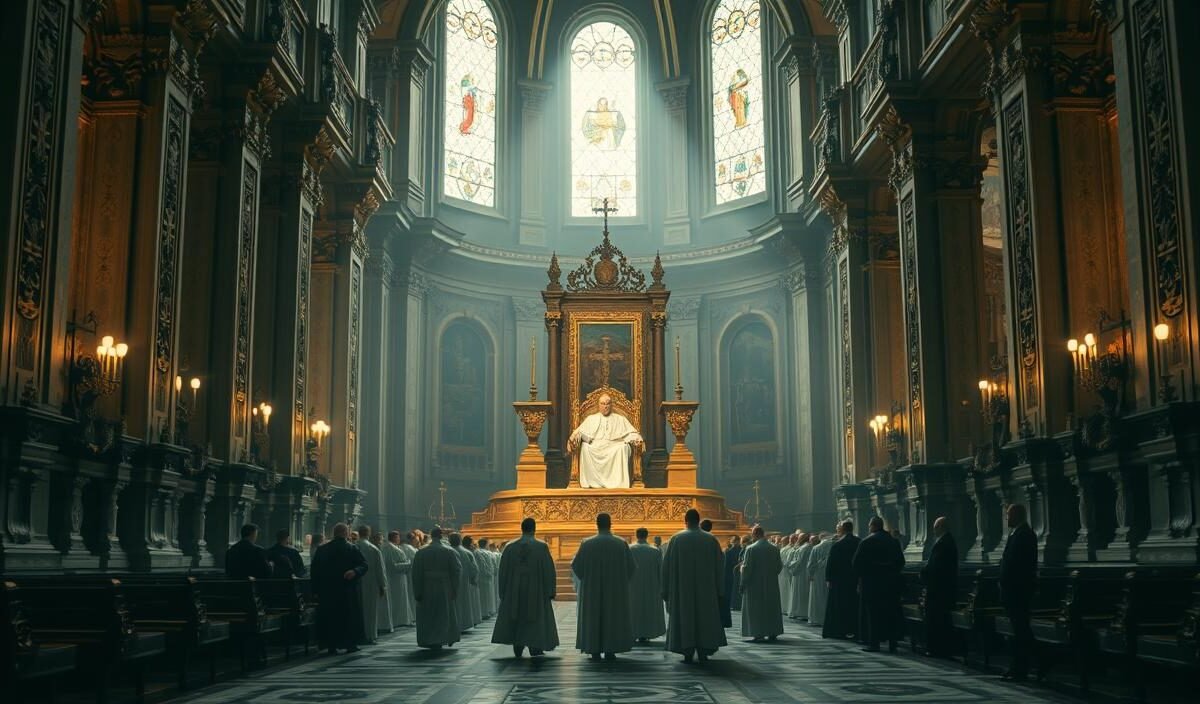
The Conclave is an election process conducted by the College of Cardinals to choose the new Pope. During the Conclave, the cardinals isolate themselves from the outside world and cast secret ballots until one candidate obtains the required two-thirds majority of the votes.
Preparations for the Conclave involve several steps, including Mass Holy Spirit (Holy Spirit) to invoke divine guidance. The cardinals then proceed to the Sistine Chapel, where the voting takes place. Each cardinal swears not to reveal anything about the process and votes in secret.
The white smoke and other rituals of the papal election
One of the most symbolic aspects of the Conclave is the use of smoke to indicate the outcome of the voting. White smoke signals that a new pope has been elected, while black smoke indicates that the vote did not result in a definitive choice.
In addition to the smoke, other rituals include the cardinals’ oath to follow the rules of the Conclave and the destruction of the ballots after the election to ensure secrecy.
Changes in the election process throughout history
Over the centuries, the papal election process has undergone several significant changes. One of the most notable was introduced by Pope Gregory X in the 13th century, who established the isolation of the cardinals during the Conclave to prevent outside influence.
More recently, Pope John Paul II revised the rules of the Conclave to modernize the process and ensure its integrity. These changes reflect the challenges faced by the Church during different historical periods and demonstrate the institution’s ability to adapt.
By understanding how popes are elected, you can appreciate the complexity and importance of this process for the Catholic Church. The Conclave is not just a tradition, but a vital mechanism for the continuity of the Church’s spiritual leadership.


The Pope's Authority in the Catholic Church
Have you ever wondered how the Pope exercises his authority in the Catholic Church? The Pope’s authority is a complex and multifaceted topic, encompassing not only matters of faith and morality, but also discipline and administration.
The Dogma of Papal Infallibility
The dogma of papal infallibility is one of the most important aspects of the Pope's authority. According to this dogma, the Pope is considered infallible when he speaks ex cathedra, that is, when it defines a doctrine concerning faith or morals as binding on the entire Church.
This dogma was officially defined at the First Vatican Council in 1870 and is seen as a guarantee of the continuity and unity of the Catholic faith.
The Primacy of Peter and His Successors
The primacy of Peter and his successors is another fundamental aspect of the Pope’s authority. According to Catholic tradition, Peter was chosen by Jesus to lead the apostles and, by extension, the Church.
The successors of Peter—the popes—inherit this authority and are considered the spiritual leaders of the Catholic Church.
The Power to Govern the Universal Church
The Pope has the authority to govern the Universal Church, which includes not only matters of faith and morals, but also those of discipline and administration. This authority is exercised through Canon Law, the Congregations of the Roman Curia, and his representatives throughout the world.
The Pope governs the Church through various official documents, such as encyclicals, apostolic exhortations, and apostolic letters.
Here is a table summarizing the main ways in which the Pope exercises his authority:
| Form of Exercise | Description |
|---|---|
| Encyclicals | Documents that address important issues of faith and morality. |
| Apostolic Exhortations | Documents that encourage the faithful to live in accordance with the Catholic faith. |
| Apostolic Letters | Documents that address issues specific to the Church. |
| Canon Law | A body of laws governing the Catholic Church. |
The Pope also appoints bishops, establishes dioceses, convenes councils and synods, and makes other important decisions regarding the life of the Church.

The Pope’s authority is exercised in a manner adapted to the different cultural and social contexts in which the Church is present.
According to the First Vatican Council, “If, therefore, anyone says that the Roman Pontiff has only the office of supervision or guidance, but not full and supreme power of jurisdiction over the entire Church… let him be excommunicated.”
“If, therefore, anyone says that the Roman Pontiff has only the office of supervision or guidance, but not the full and supreme power of jurisdiction over the entire Church—not only in matters pertaining to faith and morals, but also in those pertaining to the discipline and governance of the Church, spread throughout the world; or say that he enjoys only the principal part of this supreme power, and not its full extent; or say that this power of his is not ordinary and immediate, whether over each and every church or over each and every pastor and faithful—let him be excommunicated.”
The Powers and Functions of the Supreme Pontiff
The Supreme Pontiff holds unique authority within the Catholic Church, exercising powers that directly influence ecclesiastical life. As a spiritual leader, the pope has a wide range of responsibilities that are fundamental to the governance of the Church.
The Pope's Executive Powers
The pope has the right to appoint bishops and prelates, and may also confirm appointments made by others, as is the case in the Eastern Catholic Churches. Furthermore, only the pope can transfer bishops from one see to another, accept their resignation or retirement, and, in serious cases, depose them.
Examples of Executive Powers:
| Power | Description |
|---|---|
| Appointment of Bishops | The pope appoints bishops to lead dioceses around the world. |
| Transfer of Bishops | The pope may transfer bishops from one diocese to another as needed. |
| Acceptance of Resignation | The pope accepts the resignation or retirement of bishops. |
Legislative Powers and Canon Law
The pope also holds legislative powers and can enact laws and regulations for the Catholic Church. This includes the authority to approve new religious orders and institutes, establishing their rules and standards of conduct.
“The pope is the supreme lawmaker of the Catholic Church, with the authority to create and interpret canon law.”
Judicial Branches and Decisions on Faith
In addition, the pope exercises judicial powers and may adjudicate cases in the final instance within the Church. This includes the ability to intervene directly in any ecclesiastical case or to assume jurisdiction over cases currently pending in lower courts.
- The pope has the authority to adjudicate cases as the final authority within the Catholic Church.
- The pontiff may intervene directly in any ecclesiastical matter.
- The pope exercises his judicial authority through the courts of the Holy See.
By understanding the powers and duties of the Supreme Pontiff, you can gain a better understanding of the structure and functioning of the Catholic Church. The pope, as a spiritual leader, plays a crucial role in guiding the faith of Catholics around the world.
The Vatican: The Seat of the Papacy

In the heart of Rome lies the Vatican, the seat of the Catholic Church. The Vatican is an internationally recognized sovereign state that is home to the papacy.
The Vatican has a rich history dating back to the Papal States. The History of the Papal States It is fascinating and involves the evolution of the Catholic Church's temporal power.
The History of the Papal States
The Papal States existed for more than a thousand years, until the unification of Italy in the 19th century. During that period, the Catholic Church exercised not only spiritual power but also temporal power.
The history of the Papal States is marked by periods of great influence and turmoil. The Church played a crucial role in European politics, and the popes were central figures in diplomacy and government.
The Vatican as a sovereign state
The Vatican is an internationally recognized sovereign state. It has its own currency, postage stamps, and even a police force.
The Vatican's sovereignty allows the Catholic Church to maintain its independence and carry out its spiritual mission without interference.
The Roman Curia and Its Organization
The Roman Curia is the collection of bodies that assist the pope in governing the Catholic Church. It is composed of dicasteries, which include congregations, tribunals, and offices.
A Roman Curia It is essential to the functioning of the Church, as it coordinates the activities of the Catholic Church worldwide and supports the pope in his mission.
By understanding the structure and role of the Vatican, you can better understand how the Catholic Church is governed and how the pope exercises his authority.
All About the Popes: Fun Facts and Surprising Facts
Did you know that the history of the popes is full of interesting facts and surprising details, ranging from the choice of their names to their daily routines? In this section, we’ll explore some of these intriguing facts that highlight the diversity and richness of the history of the papacy.
The Youngest and Oldest Popes in History
The age of popes when they take office is an interesting point. The youngest pope in history was Benedict IX, who became pope at the age of just 20 years old in 1032. On the other hand, the oldest pope was Clement XII, elected with 78 years old in 1730. These extreme periods show how the history of the papacy is marked by a wide variety of experiences and challenges.
The Longest and Shortest Pontificates
The lengths of time that popes remain in office are also noteworthy. The the longest-living pope was Pius IX, who remained in office for 31 years old, from 1846 to 1878. As for the shortest pontificate was that of Urban VII, which lasted only 13 days in 1590. These durations reflect the different historical circumstances and the choices made during the conclaves.
Popes Who Resigned from Office
A pope's resignation is a rare event in the history of the Catholic Church. A recent example is that of Benedict XVI, who resigned in 2013, citing old age and lack of strength to remain in office. Before him, Celestine V He resigned in 1294, after only five months as pope. These resignations show that, although the papacy is a lifetime position, there are times when popes decide to step down for various reasons.
Interesting Facts About the Popes' Daily Lives
The daily lives of popes are marked by a routine that includes prayers, audiences, and administrative work. Did you know that popes have a daily routine that begins very early, with prayer and a private Mass? Furthermore, modern popes must balance their public duties with the need to privacy and moments of solitude. Baby food is also interesting, as some babies have specific culinary preferences.
One fascinating aspect is how the popes maintain their spiritual life amid so many responsibilities. They have moments of reflection and prayer, as well as meetings with religious and secular leaders. The life of a pope is at once extraordinary and ordinary, marked by great responsibilities, but also by human needs and habits just like anyone else's.

These interesting facts and surprising tidbits about the popes highlight the complexity and richness of the history of the papacy. From the popes’ extreme ages to their daily routines, there is much to discover and understand about these religious leaders.
Baby Names and Their Meanings
Have you ever wondered why popes change their names when they are elected? This tradition is one of the most fascinating in the history of the papacy. The choice of a papal name is a crucial moment which reflects the identity and mission of the new pontiff at the helm of the Catholic Church.
Over the centuries, the practice of changing one's name has become a well-established tradition. But why is that? One of the main reasons It is a tribute to former popes or important figures in the Church.
By choosing a new name, the pope signals his intention to follow in the footsteps of his predecessors and continue their work.
Why do popes change their names when they are elected?
The practice of changing one's name dates back to the 6th century, with Pope John II being one of the first to do so. Since then, it has become the norm.
The choice of a name is influenced by several factors, including devotion to a saint or a previous pope whose policies or spirituality the new pontiff wishes to emulate.
To learn more about the history of the papacy and its traditions, you can visit this link.
The Most Popular Names Chosen by Popes
Some names stand out on the list of papal names. “John” is the most common name, having been chosen 21 times, with John XXIII being the last to bear that name. Other popular names include “Bento,” “Gregório,” “Clemente,” “Leão,” and “Inocêncio.”. These names carry historical and spiritual significance which influences the selection of popes.
- John (21 times, with John XXIII being the last)
- Benedict (16 times, with Benedict XVI being the last)
- Gregory (16 times, with Gregory XVI being the last)
- Clement (14 times, with Clement XIV being the last)
- Leo (14 times, with Leo XIII being the last)
- Innocent (13 times, with Innocent XIII being the last)
Popes Who Kept Their Baptismal Names
Although changing one's name is a well-established tradition, some popes have kept their baptismal names. This was more common in the early centuries of the Church. Marcel II and Hadrian VI are examples of porridges that haven't changed their names.
Reasons for keeping the original name may include personal devotion or a desire for continuity.
The practice of keeping one's baptismal name has become increasingly rare over the centuries. In the last 500 years, no pope has kept his baptismal name, reflecting the strong tradition of choosing a new name upon being elected.
The Most Influential Popes in History
Have you ever wondered which popes had the greatest impact on the history of the Catholic Church? Over the centuries, several popes have stood out for their significant contributions, shaping not only the Church but also the course of world history.
Gregory I, the Great: The Pope Who Reformed the Church
Gregory I, known as Gregory the Great, was one of the most influential popes in history. He reigned from 590 to 604 and is remembered for his significant reforms within the Catholic Church.
Gregory I played a crucial role in the evangelization of the Anglo-Saxon peoples by sending missionaries to England. In addition, he was a prolific writer, and his writings had a lasting impact on the theology and liturgy of the Church.
Key facts about Gregory I:
- He reformed the liturgy and the administration of the Church.
- He began the evangelization of the Anglo-Saxons.
- His writings influenced Catholic theology.
Leo I and His Confrontation with Attila
Leo I, also known as Leo the Great, was pope from 440 to 461 and is famous for his meeting with Attila, the leader of the Huns, in 452. Leo I convinced Attila not to invade Rome, an event that saved the city and had a significant impact on European history.
In addition, Leo I was a defender of Catholic orthodoxy and played an important role in defining Christology.
Innocent III and the Height of Medieval Papal Power
Innocent III, who reigned from 1198 to 1216, is considered one of the most powerful popes of the Middle Ages. He consolidated papal power by intervening in political matters throughout Europe and organizing the Fourth Crusade.
Innocent III also convened the Fourth Lateran Council, an event that had significant implications for the doctrine and practice of the Catholic Church.
John Paul II and His Impact on the Modern World
John Paul II, the first Polish pope in history, served from 1978 to 2005 and had a profound impact on the modern world. He played a crucial role in the collapse of communism in Eastern Europe, especially in Poland. John Paul II was a tireless traveler, visiting 129 countries and spreading the Catholic Church’s message to every continent.
He also strengthened interfaith dialogue, becoming the first pope to visit a synagogue and a mosque.
During his long pontificate, John Paul II wrote several encyclicals and apostolic exhortations that continue to influence the Catholic Church today. His personal example of faith and courage in the face of illness has inspired millions of people around the world.
John Paul II's Major Achievements:
- It contributed significantly to the collapse of communism.
- It strengthened interfaith dialogue.
- He inspired the faithful with his faith and resilience.
Brazilian and Latin American Popes
The papacy has a long history of interaction with Latin America, and you’ll learn more about that relationship. The Catholic Church has a significant presence in the region, and this is reflected in the influence that Latin American cardinals wield in the Vatican.
Latin American Representation in the Papacy
Latin America has a rich history of contributing to the papacy. Although there had never been a pope directly from Latin America until the election of the Pope Francis, the region has exerted significant influence on papal elections.
Latin American cardinals have played crucial roles in conclaves, reflecting the region's importance to the Catholic Church.
Latin America's representation in the College of Cardinals has grown over the years, reflecting the region's increasing influence on the decisions of the universal Church.
You'll learn about the Brazilian cardinals who have participated in conclaves throughout history, representing the world's largest Catholic nation.
- Brazilian cardinals considered “papable” in various conclaves.
- The role of Brazilian cardinals in recent conclaves.
- The influence of Brazilian cardinals on the decisions of the universal Church.
Pope Francis and His Ties to Latin America
Pope Francis, the first Pope from Latin America, has brought a new perspective to the papacy. His election in 2013 was a milestone in the history of the Catholic Church, highlighting the region’s importance on the global Catholic stage.
Pope Francis has deep ties to Latin America. As a cardinal, he played a crucial role in the Archdiocese of Buenos Aires, and his experience in the region has influenced his pastoral approach and his priorities as Pope.
Brazilian Cardinals Who Participated in Conclaves
Brazil, as the world’s largest Catholic nation, has a long history of cardinals who have participated in conclaves. Some of the most notable Brazilian cardinals include those who were considered “papable” in various conclaves.
You will come to understand the influence these cardinals have had on the decisions of the universal Church and their contribution to the dialogue between Rome and the Church in Brazil. The list of Brazilian cardinals who have participated in conclaves is a testament to Brazil’s importance to the Catholic Church.
Papal Symbols and Vestments
Papal symbols and vestments offer a glimpse into the rich history and spirituality of the Catholic Church. You will explore the meanings behind these elements and gain an understanding of their importance in the liturgy and in the Pope’s life.
The Papal Tiara and Its Meaning
The Papal Tiara, also known as the “triregnum,” was a symbol of the popes’ temporal power. The last pope to wear it was Paul VI.
The Fisherman's Ring and Its Use
The Fisherman's Ring is one of the most significant symbols of the papacy, representing the Pope's authority.
The Pope's Liturgical Vestments
The Pope's liturgical vestments are rich in meaning and reflect the tradition of the Catholic Church.
The Papal Crosier and Other Symbols of Authority
The papal crozier differs from the bishops' crozier in that it has a cross instead of a curve, symbolizing the pontiff's universal authority.
The use of the ferula—a rod with a cross—is another symbol of the Pope's jurisdiction.
Over time, these symbols have evolved; some have been abandoned in favor of greater simplicity, while others have been adapted to meet contemporary needs. The sedia gestatoria and the popemobile are examples of how tradition adapts to new needs.
Controversies in the History of the Papacy
The history of the papacy is marked by numerous controversies that have significantly influenced the course of the Catholic Church. You will learn about some of the most significant ones, including the Great Western Schism, the influence of the Borgia popes during the Renaissance, and the role of Pope Pius XII during World War II.
The Great Western Schism and the Antipopes
The Great Western Schism, which took place between 1378 and 1417, was a period of great division within the Catholic Church. During that time, there was more than one pope, leading to the existence of antipopes.
This schism was the result of political and theological disputes that culminated in the election of rival popes.
You can better understand this complex situation by examining the table below, which summarizes the main events and figures of the Great Western Schism.
| Period | Pope/Antipope | Location |
|---|---|---|
| 1378-1394 | Urban VI | Rome |
| 1378-1394 | Clement VII (Antipope) | Avignon |
| 1394-1423 | Benedict XIII (Antipope) | Avignon |
The Borgia Popes and the Renaissance
During the Renaissance, the Borgia family rose to the papacy and wielded significant influence. Pope Alexander VI, a prominent member of that family, was known for his controversial actions, including nepotism and involvement in political intrigues.
The actions of the Borgia popes are an example of how politics and religion were intertwined during the Renaissance, leading to both positive and negative consequences for the Catholic Church.
The Papacy During World War II
One of the most hotly debated controversies surrounding the modern papacy involves Pope Pius XII’s actions during World War II and the Holocaust. You will discover the different perspectives on Pius XII’s “silence” in the face of Nazi atrocities.
Some critics argue that Pius XII did not make sufficiently explicit statements against the genocide, while his defenders point to his behind-the-scenes diplomatic efforts and the Church’s actions to save Jews.
The complexity of this historical issue involves considerations regarding diplomacy, morality, and the role of the Church in times of global crisis. The opening of the Vatican archives has provided new evidence and perspectives on this issue.
By examining these events, you can better understand the nuances involved and their implications for the history of the Catholic Church.
The Papal Succession: A Complete List of Popes
You are about to delve into the rich history of the popes by exploring the complete list of leaders of the Catholic Church. The papal succession is a fascinating topic that reveals the continuity of the Church throughout the centuries.
On this journey, you'll learn about the popes who have shaped history, from the early days of the Church to the present.
The First Popes and the Early Church
The history of the popes begins with Saint Peter, who is considered the first pope. He was one of the apostles of Jesus Christ and played a key role in the founding of the Catholic Church.
The early popes faced significant challenges, including persecution and theological debates. They played a crucial role in laying the foundations of Christian doctrine.
During the early centuries, the Catholic Church experienced periods of peace and persecution. The popes led the Christian community, guiding it through these difficult times.
Apostolic succession, which refers to the transmission of authority from the apostles to the bishops, was an important concept during this period.
Popes of the Middle Ages and the Renaissance
During the Middle Ages, the papacy played a central role in European politics and religion. Popes such as Gregory VII and Innocent III exerted great influence, not only in matters of the Church but also in secular politics.
The Renaissance brought about significant changes, with popes such as Leo X, who was a great patron of the arts.
The list of popes from this period includes notable figures who contributed to art, theology, and politics. They faced challenges such as corruption and schism, but they also promoted reforms and cultural advances.
| Pope | Period | Notes |
|---|---|---|
| Gregory VII | 1073-1085 | Reformer, known for his fight against lay investiture |
| Innocent III | 1198-1216 | One of the most powerful popes of the Middle Ages, he convened the Fourth Lateran Council |
| Leo X | 1513-1521 | A member of the Medici family, known for his patronage of the arts |
Popes from the Modern Era to the Present Day
The Modern Era brought great challenges to the Catholic Church, including the French Revolution, the two World Wars, and the Cold War. Popes such as Pius IX, Leo XIII, John XXIII, and John Paul II played crucial roles during these periods.
Pius IX defined the dogma of Papal Infallibility in 1870, a significant moment in the history of the papacy. Leo XIII is known for his social doctrine, which addressed issues such as social justice and workers' rights.
John Paul II had a global impact, contributing to the fall of communism in Europe.
Benedict XVI’s resignation in 2013 was a historic event, marking the first time in nearly 600 years that a pope had stepped down from office. His successor, Francis, is the first Latin American pope, bringing a new perspective to the papacy.
“The Catholic Church is a living institution with a rich and complex history. The popes have been central figures in that history, guiding the Church through times of peace and turmoil.”
The list of popes of the modern era is a testament to the Catholic Church’s continuity and its ability to adapt to changes in the world. From Pius IX to Francis, each pope has contributed in a unique way to the Church’s mission.
The Canonization Process and Saintly Popes
The Catholic Church recognized the sanctity of John Paul II through a process of canonization unprecedented. You are about to discover how this process unfolded and what it means for the Catholic Church.
Popes Who Have Been Canonized
Throughout the history of the Catholic Church, several popes have been canonized as saints. John Paul II is one of the most recent and significant examples.
His canonization was a complex process that involved several stages and verifications. Other canonized popes include Saint Peter, considered the first pope, and Saint Gregory I, known for his reforms in the Church.
The canonization process is rigorous and involves verifying the life and miracles attributed to the candidate for sainthood. In the case of John Paul II, his canonization was expedited due to his popularity and the recognition of his miracles.
The canonization process led by the popes
Pope Benedict XVI played a crucial role in the canonization of John Paul II. Benedict XVI waived the usual five-year waiting period following death to begin the beatification process. This demonstrates the importance the Church attaches to the figure of John Paul II.
The canonization process is conducted by the Congregation for the Causes of Saints, which investigates the candidate's life and miracles. In the case of John Paul II, two miracles were attributed to his intercession: the healing of a French nun with Parkinson's disease and that of a Costa Rican woman with a brain aneurysm.
The Beatification and Canonization of John Paul II
The beatification of John Paul II took place in 2011, presided over by Benedict XVI, while his canonization took place in 2014, presided over by Pope Francis. Both events drew millions of pilgrims to Rome, demonstrating the worldwide devotion to John Paul II.
The canonization of John Paul II is significant not only for the Catholic Church, but also for the millions of faithful who knew him during his long pontificate. It reflects his lasting influence and the respect he inspired around the world.
The Papacy in the 21st Century: Challenges and Transformations
In the 21st century, the papacy faces a series of complex challenges that require effective moral and spiritual leadership. You are about to discover how the Catholic Church, led by the pope, addresses these issues.
The Resignation of Benedict XVI and Its Historical Significance
Pope Benedict XVI’s resignation in 2013 was an unprecedented event in the recent history of the Catholic Church. You may wonder why it was so significant.
In short, it was the first time a pope had resigned from office in nearly 600 years, since Gregory XII in 1415. This decision highlighted the complexity of the demands placed on the papacy and the need for adaptable leadership.
Pope Benedict XVI, the 265th pope in the line of succession beginning with Saint Peter, announced his resignation on February 11, 2013, which took effect on February 28 of that same year.
This action was seen as a significant step for the Church, demonstrating the pope's willingness to prioritize the institution's well-being.
The Use of Social Media and New Technologies
The papacy has also embraced new technologies to communicate with the faithful and the world. Pope Francis’s use of social media, for example, has been a powerful tool for reaching a broader and more diverse audience.
You can follow the Pope's posts on major social media platforms, where he shares his reflections and guidance.
The adoption of these technologies represents an effort to make the Church's message more accessible and relevant to younger generations and to those living in different parts of the world.
The Challenges Facing the Papacy in the Contemporary World
The papacy faces a series of challenges in the modern world, ranging from internal Church issues to global problems that require moral leadership. Among these challenges are the sexual abuse scandal, the reform of the Roman Curia, and the decline in religious practice in the West.
| Challenge | Description |
|---|---|
| Sexual Abuse Scandal | A crisis that undermined trust in the Church and demanded effective responses from the papacy. |
| Reform of the Roman Curia | An effort to modernize and streamline the Church's administration. |
| Decline in Religious Practice | A trend that challenges the Church to find ways to remain relevant. |
In addition, the pope plays a crucial role in global issues such as climate change, migration, poverty, and armed conflicts. The pope’s moral leadership is essential for inspiring action and dialogue on these issues.
You can see that the papacy continues to evolve, seeking to balance fidelity to Catholic tradition with the need for dialogue with the contemporary world.
Conclusion
Now that you know all about the porridge, from the origins of the papacy with Saint Peter to the challenges faced by the pontiff in the 21st century, it is possible to better understand the importance of the Catholic Church in world history.
The institution of the papacy has evolved significantly over the course of two millennia, adapting to different historical contexts while maintaining its essence as the center of unity for the Church.
You can now see how the porridge, with their diverse personalities and charisms, helped shape not only the Church but also the history of Western civilization.
The wealth of traditions, symbols, and rituals surrounding the papacy expresses its spiritual authority and its role as the successor to Peter. From the choice of the papal name to the rituals of the conclave, every detail carries a profound meaning that reflects both continuity and change within the Church.
By understanding the history and significance of the papacy, you can now better appreciate the complexity and importance of this millennia-old institution. The pope continues to exert significant influence in the contemporary world, facing challenges and embracing new opportunities.
The history of porridge It is a fascinating story of faith, power, and transformation. By exploring this story, you have gained valuable insights into the history the Church and its impact on the world.
Now, with a deeper understanding of the Catholic Church and through its spiritual leadership, you are better equipped to appreciate the rich tapestry of Christian history and the ongoing role of the pope in it.
As we conclude this journey through the history of the popes, it is clear that the institution of the papacy remains a vital force in the Church and around the world, with the pope playing a central role in spiritual guidance and decision-making.
FAQ
Q: Who was the first pope of the Catholic Church?
A: Saint Peter is considered the first Pope of the Catholic Church, according to Catholic tradition and the Holy Scriptures.
Q: What is the Conclave, and how does it work?
A: The Conclave is the process by which the Pope is elected by the cardinals of the Catholic Church. During the Conclave, the cardinals gather at the Vatican and vote until a new Pope is elected.
Q: What is the meaning of the title “Pope”?
A: The title “Pope” comes from the Greek word “pappas,” which means “father.” It is a title used to refer to the Bishop of Rome and the head of the Catholic Church.
Q: What powers does the Pope have in the Catholic Church?
A: The Pope has executive, legislative, and judicial powers within the Catholic Church, and is considered the successor to Saint Peter and the head of the Universal Church.
Q: What is papal infallibility?
A: Papal infallibility is a dogma of the Catholic Church that states that the Pope is infallible when he speaks ex cathedra—that is, when he defines a doctrine or teaching as infallible.
Q: Who was the youngest pope in history?
A: The youngest pope in history was Pope Gregory V, who was elected at the age of just 24.
Q: What is the Vatican's role in the Catholic Church?
A: The Vatican is the seat of the papacy and the administrative center of the Catholic Church, and it is home to the Roman Curia, which is the central government of the Church.
Q: How are popes elected?
A: Popes are elected through the Conclave, a process involving the cardinals of the Catholic Church that takes place at the Vatican.