I feel a sense of awe whenever I open the Scriptures to the account of Abram.
I imagine the weight of silence being broken by the Creator’s voice in a distant land.
I realize that the Chapter 12 of Genesis It is not just an old historical record.
In him, I find a roadmap for any soul that feels restless and called to something greater.
I invite you to walk with me along these ancient sands today.
I understand that one man’s obedience changed the course of eternity for all of us—you and me.
The Radical Call and the Awakening to Obedience
I believe that the beginning of this story reveals the essence of what it means to trust completely.
God does not provide a complete roadmap, but rather an invitation to absolute dependence.
The biblical text presents us with a command that echoes through the centuries.
In this context, the divine voice interrupts the daily routine of a man living in Haran.
The meaning of “Lekh Lekha” in Hebrew
The original Hebrew text uses the phrase “Lekh Lekha” for the call.
Scholars point out that this literally means “go to yourself” or “go for yourself.”.
I see this as a journey of self-discovery through radical obedience.
To discover who he truly was in God, Abram had to leave behind who he was on earth.
A Break with the Past and Comfort
Abram lived in a prosperous region, surrounded by the security of his family.
According to Christian tradition, leaving the “Father’s house” meant giving up the social protection available at the time.
In this verse, I find a challenge to my own current comfort zones.
Often, the promise requires me to let go of what is familiar in order to embrace what is eternal.
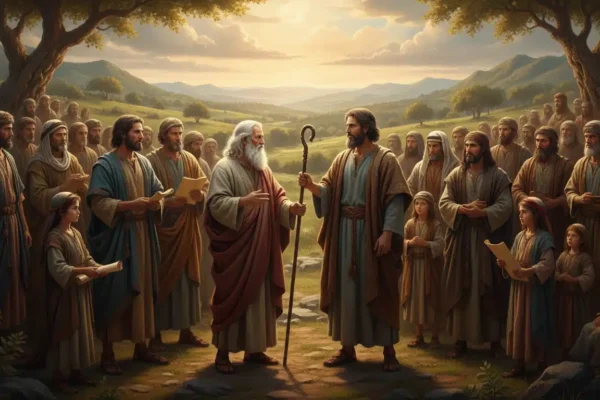
“Then the Lord said to Abram, ”Leave your country, your relatives, and your father’s house, and go to the land that I will show you.’” (Genesis 12:1)
The voice that calls is the same voice that sustains every step taken into the unknown.
The Threefold Promise in Genesis Chapter 12
I note that God’s promise to Abram has three fundamental and inseparable aspects.
God offers land, descendants, and a blessing that extends to all of humanity.
O Genesis Chapter 12 This establishes what theology calls the Abrahamic Covenant.
It is a one-sided commitment in which the Lord’s faithfulness is the only real guarantee.
A blessing that reaches every family
I believe that the highlight of this promise lies in the universal scope of God's plan.
God says, “All the families of the earth will be blessed through you,” pointing to the Messiah.
I realize that my own faith today is a direct result of that word spoken millennia ago.
Abraham's lineage would not be merely biological, but a tree of faith for the world.
The Historical Impact of Abraham's Descendants
Historians suggest that Abram's migration coincides with migratory shifts in the Middle East.
Even so, their journey stands out for being guided by a unique monotheistic revelation.
I see in the promise of the “great nation” the birth of a people with a priestly calling.
It was not a matter of political power, but of serving as a channel of divine light among the nations.
The promise was not a final destination, but the fuel for a journey of faith.
The Physical and Spiritual Journey Toward Canaan
I accompany Abram on his journey and realize that the path is just as important as the destination.
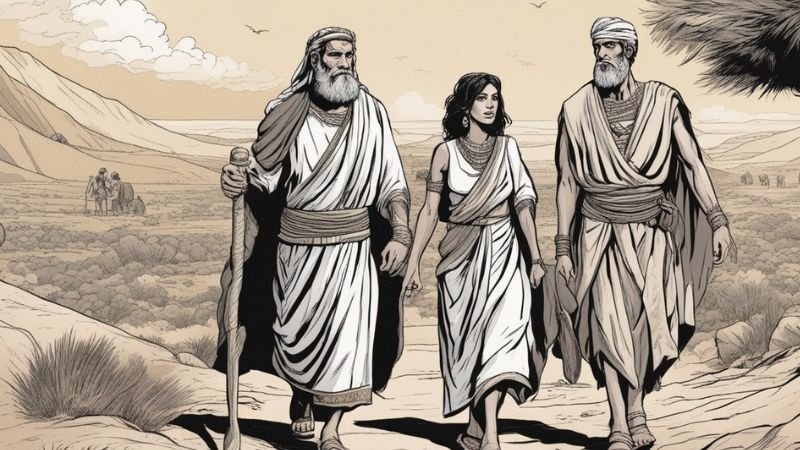
He travels with his wife Sarai, his nephew Lot, and all the possessions they had accumulated.
The journey through the fertile crescent required physical endurance and unshakable spiritual confidence.
Every kilometer they traveled was a testament to the fact that God’s word was trustworthy.
Altars as symbols of gratitude and faith
I find frequent references in the text to the altars that Abram built along the way.
In Shechem and in Bethel, he stopped to call upon the name of the Lord in public.
I understand that these altars were declarations of spiritual ownership over the Promised Land.
They served as visible reminders that God was present on that still-foreign soil.
Crossing the desert with our eyes fixed on the promise
Abraham's journey was no easy ride, but a journey of constant trials.
I realize that faith doesn't spare us from fatigue, but it gives us a reason to keep going.
Upon arriving at Canaan, he finds the land occupied by other peoples and suffering from severe famine.
At this point, I invite you to reflect on how we react when reality fails to live up to the promise.
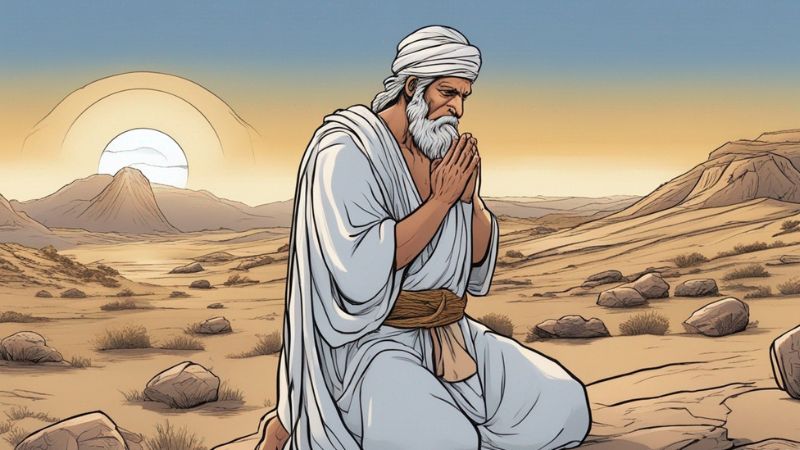
✝️ Reflection: Abraham’s altars were not lavish temples, but piles of stones. True worship takes place in the simplicity of recognizing that God is our guide.
The journey, however, takes an unexpected turn when human fear begins to whisper louder.



Human Fragility and Lies in Egypt
I admit that I feel a certain sense of relief when I read about Abram's failures in the Genesis Chapter 12.
This shows me that God chooses real, imperfect, and often fearful people.
Faced with extreme famine, Abram decides to go down to Egypt to ensure his family's survival.
There, the patriarch of the faith falters and tries to save his own life by telling a half-truth.
The fear that silences confidence
By saying that Sarai was merely his sister, Abram reveals a human tendency to protect himself.
I believe he momentarily forgot that the One who called him was powerful enough to protect him.
I realize that fear has the power to distort our perception of reality and of divine sovereignty.
Even the giants of faith have moments when the shadow of uncertainty seems greater than the light.
God's Faithfulness Despite Our Mistakes
What strikes me most about this passage is that God does not abandon Abram in his error.
Divine grace intervenes to protect Sarai and preserve the integrity of the promised lineage.
I understand that God's plans are greater than our momentary lapses in character.
He protects His chosen ones not because they are perfect, but because He is faithful to His word.
Even in the midst of error, God’s hand moves to restore what was in danger.
Divine Protection and Leaving Egypt
I see God acting with authority over the nations to protect His purpose for Abram.
The Pharaoh and his household suffer the consequences of Sarai's presence in his palace.
Divine intervention through plagues reveals that the Lord is faithful to His covenant.
O Genesis Chapter 12 shows us that God is the true defender of those He calls.
When God Intervenes in Our Silences
Abram did not speak out in Egypt; he remained silent while the lie grew to dangerous proportions.
I feel that sometimes God comes to our aid even when we’re paralyzed by our own mistakes.
Abram's expulsion from Egypt was a deliverance disguised as a public rebuke.
He leaves there richer in material possessions, but certainly more humble in spirit.
A Return to the Altar of Prayer
I believe that Egypt was the school of dependence that Abram needed to reach the next level.
He learned that provision outside of God's will brings complications that faith does not desire.
The exodus from Egypt marks a geographical and spiritual return to the place where it all began.
Here I find a lesson on the importance of returning to one’s “first love” and to the original altar.
The experience in Egypt paved the way for the alliance's definitive consolidation.
The Return to Canaan and the Consolidation of the Covenant
I see Abram traveling from Egypt toward the Negev, returning to the site of the altar.
This return symbolizes the restoration of fellowship and the reaffirmation of their commitment to God.
O Genesis Chapter 12 It ends with Abram settled once again in the Promised Land.
He now carries with him not only possessions, but the living experience of the Lord’s faithfulness.
Rebuilding Faith After Failure
I believe that spiritual maturity comes from our ability to start over with God.
Abraham did not allow the mistake he made in Egypt to define the rest of his life.
I understand that he returns to Bethel, which means “House of God,” to call upon the Name.
It is the gesture of someone who recognizes that, without divine guidance, all wealth is meaningless.
The Eternal Inheritance of the Promised Land
The land of Canaan is now not just a geographic destination, but a symbol of heritage.
Christian tradition sees this possession as a foreshadowing of the heavenly inheritance that awaits the faithful.
I understand that Abram’s journey laid the foundation for the entire history of redemption.
What began as a solitary step of obedience has become a path for multitudes.
Share this with someone who needs to hear this message 🙏
FAQ — Common Questions About Genesis Chapter 12
I get a lot of questions about the nuances of this text and how it applies to our crises of faith today.
I believe this illustrates the tension between our faith and our fragile human nature.
Abram looked at the dangerous circumstances and allowed fear to cloud his confidence in divine protection.
I understand that this promise is fully fulfilled in Jesus Christ, a direct descendant of Abram.
Through faith in Christ, people of any nation can receive the same spiritual inheritance as Abraham.
Scholars note that Ur was one of the most developed cities in Mesopotamia, with a strong emphasis on trade.
Abram's departure meant leaving behind the pinnacle of civilization at that time to live as a pilgrim.
My Final Thoughts
Meeting at the Genesis Chapter 12 a mirror for my own soul and journey.
The story of Abram teaches me that God’s call is an invitation to an adventure of faith.
I realize that God doesn't expect immediate perfection, but a constant willingness to keep moving forward.
Even when we fail, the grace of the One who called us is enough to bring us back to the altar.
I believe the most important lesson is that God’s blessings in our lives are always meant to benefit others.
We have been called to be channels—not dams—of the Creator’s goodness and light in this world.
I invite you to take the next step that God has been whispering to your heart today.
What is the “land” you need to leave behind in order to embrace the promise He has for you?