
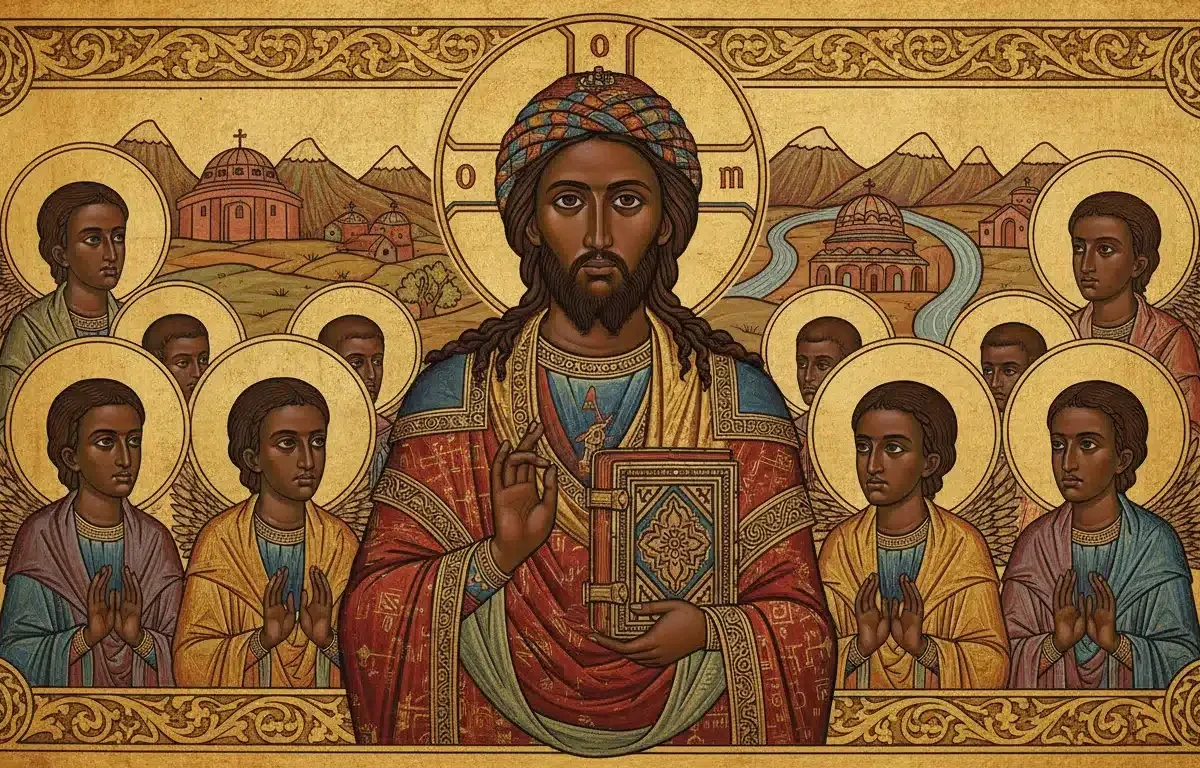
You probably grew up thinking of the Bible as that black-covered book with 66 books, right? That’s the standard version we see almost everywhere in Brazil. But what if I told you there’s a much older version—one that’s longer and full of mysteries?
We’re talking about the Bible of the Ethiopian Orthodox Tewahedo Church. It doesn’t just contain the 66 books we’re familiar with. It has 81 books. This changes a lot in terms of how the stories are told and understood.
When it comes to Jesus in the Ethiopian Bible, His figure remains that of the Savior. But the surrounding context, the prophecies, and the cultural depth are quite different. There are books there that the West set aside centuries ago.
Ethiopia was one of the first nations to adopt Christianity as its official religion. This happened long before Rome imposed its rules. As a result, they retained passages that other councils had decided to omit.
In this article, we’ll discuss how this ancient tradition views Christ. We’ll explore which apocryphal books mention Him and why this is so fascinating for those who love history and theology.
Get ready to think outside the traditional theological box. What you’re about to read here may change your perspective on how Christianity took root on the African continent.
The Ethiopian Canon: An Expanded Library
The first thing that catches your eye is its size. While Catholics have 73 books and Protestants have 66, the Ethiopian Bible contains 81 books. It is a much more extensive collection.
This difference isn't just a matter of numbers. These are texts that provide details about angels, the end times, and the lineage of Jesus. To them, all of this is sacred and inspired by God.
The term “Tewahedo” means “unified.” This already gives us a clue as to how they view the divinity of Christ, something we will discuss in more detail later. The preservation of these texts is a historical miracle.
For centuries, Ethiopia was geographically isolated by mountains and Islamic empires. This isolation protected their tradition from outside influences that might have altered or destroyed these books.
“The Ethiopian Church has the most extensive and diverse biblical canon in all of Christendom, preserving texts from the Second Temple period that have been lost in other traditions.” — Dr. R. H. Charles, scholar of biblical studies.
To us Westerners, it seems strange to add things to the Bible. To them, it was we who removed fundamental parts of the story. It’s a matter of historical perspective.
The Book of Enoch and the Figure of the Messiah
Perhaps the biggest highlight when we talk about Jesus in the Ethiopian Bible Take, for example, the Book of Enoch. In the West, it is considered apocryphal. There, it is canonical and read during liturgical services.
Why does this matter? Because the Book of Enoch contains very specific prophecies about the “Son of Man.” It describes a pre-existent Messiah who would judge the world.
These passages shaped Jewish expectations even before Jesus was born. When Jesus uses the term “Son of Man” in the Gospels, he is echoing concepts that are very prominent in Enoch.
Without this book, we lose part of the cultural context that Jesus drew upon. Having access to it within the Ethiopian Bible creates a direct connection between the Old Testament and Christ’s mission.
Check this out: the Epistle of Jude in the New Testament you have at home mentions Enoch. This shows that the early apostles were familiar with and respected this text.
The Nature of Christ: The Tewahedo Debate
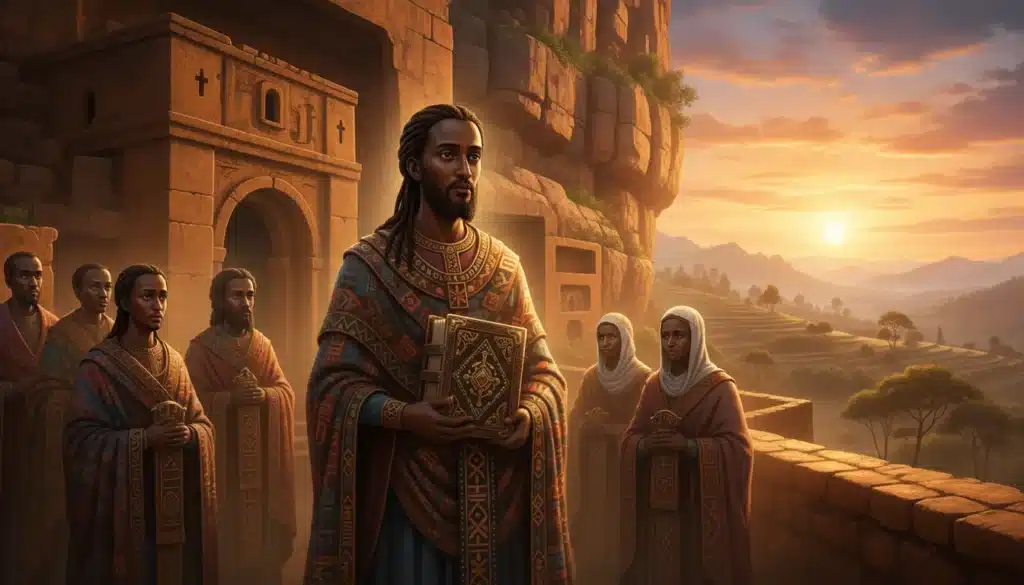
Here we enter into some complex theological territory, but I’ll keep it simple. The main difference with the Ethiopian Church lies in its view of the nature of Jesus.
At the Council of Chalcedon in 451 A.D., the European church defined that Jesus had two natures: human and divine. These natures were united, but without being mixed together.
The Ethiopian Church rejected this. They believe in the “Tewahedo” nature (a single, unified nature). For them, Christ’s humanity and divinity have become one, without separation.
Don't think that they deny that Jesus was a man. They affirm that He was perfectly divine and perfectly human, but in a single incarnate nature.
“For the Ethiopian Church, Christ is not divided. His divinity absorbed his humanity just as fire heats iron, becoming one in essence and action.” — Abuna Paulos, Patriarch of the Ethiopian Orthodox Tewahedo Church.
This belief has shaped their art, liturgy, and the way they pray. Jesus is viewed with absolute reverence, where the human does not conflict with the divine.



Kebra Nagast: The Royal Connection
Another essential book for understanding Jesus in the Ethiopian Bible and the local culture is the *Kebra Nagast* (*The Glory of the Kings*). Although it is not strictly part of the Bible, it is almost as sacred as the Bible itself.
It tells the story of the Queen of Sheba and her visit to King Solomon. According to Ethiopian tradition, they had a son, Menelik I. This son is said to have brought the Ark of the Covenant to Ethiopia.
This establishes a direct lineage between the kings of Ethiopia and the house of David. And, as we know, Jesus is of the house of David. This makes Ethiopians feel like distant relatives of Christ.
They believe that Ethiopia is the “new Israel.” The presence of the Ark of the Covenant in Axum (according to their belief) reinforces the idea that God chose that people to safeguard His mysteries.
This narrative portrays Jesus not only as a spiritual savior, but as the head of a family tree that reaches back to Ethiopia. It is a faith rooted in national identity.
Comparison: Western Bible vs. Ethiopian Bible
To make it easier to visualize, I've put together a simple table. It helps explain the structural differences between what we're used to and the Ethiopian canon.
| Features | Protestant/Catholic Bible | Ethiopian Orthodox Bible |
|---|---|---|
| Number of Books | 66 (Protestant) / 73 (Catholic) | 81 Books |
| Old Testament | Based on the Hebrew/Greek Canon | Includes Enoch, Jubilees, and the Maccabees (Ethiopic) |
| New Testament | 27 Books | 27 Books + 8 Books of Canonical Order (Clementines) |
| Book of Enoch | Considered Apocryphal | Canonical and Sacred |
| Original Language | Hebrew, Aramaic, Greek | Ge'ez (Ancient Liturgical Language) |
| Vision of Christ | Two natures (majority) | A Unified Nature (Miaphysite) |
When you look at it this way, it becomes clear that the experience of reading and studying is much broader in the African tradition. There is more context, more rules, and more history.

The Gospels of Garima
You can't talk about this subject without mentioning the Garima Gospels. These are two gospel books preserved at the Monastery of Abba Garima in Ethiopia.
Carbon dating has placed these books between 330 and 650 A.D. This makes them the world's oldest illuminated Christian manuscripts that are still bound.
This proves that devotion to Jesus in Ethiopia is ancient and sophisticated. The illustrations feature vivid colors and artistry that is on par with that of Europeans of the same period.
The physical existence of these books reinforces the authenticity of the Ethiopian faith. They did not receive Christianity from recent colonizers. They have preserved it since the early centuries.
The Influence of *The Book of Jubilees*
Another text unique to their canon is the Book of Jubilees. It retells the story of Genesis with additional details, focusing heavily on dates and laws.
Regarding Jesus in the Ethiopian Bible, Jubilees helps us understand the ancient Jewish obsession with the law and purity. This provides the perfect backdrop for understanding Jesus’ discussions with the Pharisees.
The book advocates a solar calendar, as opposed to the lunar calendar used by other Jewish groups. This shows that there was diversity of thought during the time of Christ.
Having access to the Book of Jubilees as a sacred text gives Ethiopian readers a very detailed understanding of God’s covenant with Israel. And Jesus is the ultimate fulfillment of that covenant.
The Role of Mary and the Saints
Christology (the study of Christ) in Ethiopia is inseparable from Mariology. Devotion to Mary is strong and is evident in many liturgical texts.
They believe that Mary was purified in the womb of her mother, Anna. This prepared the “temple” to receive the divinity of Jesus. The bond between Mother and Son is viewed as sacred and unbreakable.
In the Ethiopian texts, Jesus’ miracles are often accompanied by Mary’s intercession. It is a very relational and communal faith.
Another interesting fact is that Pontius Pilate is venerated as a saint in some Coptic and Ethiopian traditions. They believe he converted after the Resurrection. This completely changes his role as the villain in the story.
Why Has This Been Forgotten in the West?
The question that remains is: Why don’t we read this in our churches? The answer involves politics, geography, and theology.
Rome and Constantinople wanted to unify the empire under a single doctrine. Anything that deviated from the Greek/Latin model was viewed with suspicion.
Ethiopia, located in Africa and surrounded by the Islamic world after the 7th century, followed its own path. It did not participate in either the Protestant Reformation or the Catholic Counter-Reformation.
This allowed them to maintain a “pure” form of Christianity in relation to their Semitic origins. It is a form of Christianity with a flavor of ancient Judaism.
For those who study the Bible today, looking at Ethiopia is like looking at an old photograph of the early church. We see customs that have disappeared in Europe.
If you'd like to delve deeper into heartwarming biblical passages and teachings, it's worth checking out other content. On the Bible Phrases Channel, you'll find daily inspiration.
Current Relevance
Today, with the internet, interest in the Ethiopian Bible has skyrocketed. People all over the world want to know what else has been written about biblical times.
Learn about Jesus in the Ethiopian Bible It enriches our faith. It shows that the Gospel is universal, yet adapts and takes deep root in every culture.
We don't need to change our 66-book Bible. But we can respect and learn from the 81-book tradition of our Ethiopian brothers and sisters.
They remind us that God’s story with humanity is greater than any single book can contain. It is a living story.
Beauty lies in the diversity of the body of Christ. While we debated theology, they preserved treasures in caves and monasteries for millennia.
If you're interested in history, I recommend reading more about the subject from reliable sources. The Encyclopedia Britannica It has excellent summaries about the Tewahedo Church.
Another excellent resource for understanding ancient manuscripts is the website of the Vatican Library, which houses copies of many rare texts.
Conclusion: Jesus in the Ethiopian Bible: What Really Changes in the Story?
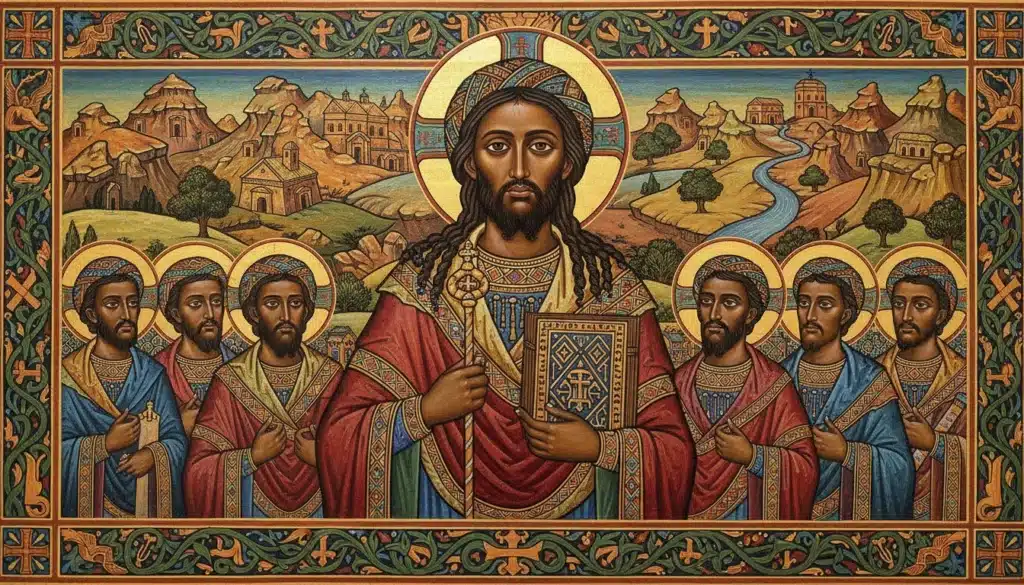
We've come to the end of this conversation about Jesus in the Ethiopian Bible. What is clear is that Ethiopian tradition offers a unique window into Christianity's past.
Jesus remains the center, the Savior, and the Son of God. But the “frame” surrounding him in this tradition is made up of older and more detailed sources, such as the Book of Enoch and the Kebra Nagast.
Differences in the number of books or in the definition of Christ’s nature should not drive us apart. On the contrary, they should make us curious about the richness of our faith.
Christianity is not a European religion. It is a global faith with deep roots in Africa. Recognizing the Ethiopian Bible means valuing this heritage.
The next time you open your Bible, remember that there are brothers and sisters in Ethiopia reading more pages, praying with the same faith, and preserving stories that time has nearly erased.
Frequently Asked Questions
No. It is the same historical and divine Jesus. The difference lies in the additional prophetic details found in books such as Enoch and in the emphasis on his unified nature (divine and human).
The Ethiopian Church has accepted and preserved ancient Jewish texts (such as Enoch and Jubilees) and early Christian texts that other Western councils chose not to include in the standard canon.
For the Ethiopian Church, it is fully inspired. For the West, it is an important historical book that helps to understand the context of the New Testament, but it is not used to define dogmatic doctrine.
It means “unified” in Ge’ez. It refers to the belief that Christ has a single nature that is, at the same time, perfectly divine and perfectly human, without any separation.
There are scholarly translations of specific books, such as Enoch and Jubilees, into Portuguese. The complete Bible, with all 81 books, is harder to find in translation; it is more commonly available in English or in the original language, Ge’ez/Amharic.
Would you like to continue learning about interesting facts and the depth of the Word? Stay tuned for our upcoming articles and share this knowledge!