

We wonder about the fate of those who walked with Christ, the pillars of our faith. The story of how the apostles died It is a powerful testament to dedication and sacrifice, echoing through the centuries and inspiring generations.
In this space for reflection, we will delve into the accounts and traditions that recount the final days of these extraordinary men. Prepare yourself for a journey that will deepen your understanding of the true essence of faith and martyrdom.
The Fate of Christ's Apostles
We often wonder what drove Jesus’ first followers.
Understanding the end of the apostles’ lives helps us understand the depth of faith.
They did not merely preach the Gospel; they sealed it with their own blood and sacrifice.
Research into their deaths serves as a way for us to see the primitive christianity.
We see ordinary men who have become spiritual giants in the face of relentless persecution.
Studying these accounts strengthens our own journey and connects us to the roots of our faith.
Each martyrdom carries a theological significance that has shaped the structure of the Church of Christ.
We realized that the message of the cross was so real that none of them shrank from death.
To visit these final destinations is to immerse yourself in a story of unwavering courage and extreme love.
The impact of their lives continues to resonate to this day in every church and in every Christian heart.
We are invited to reflect on what we would be willing to give up for that very Kingdom.
How the Apostles Peter and Paul Died

Peter, the fisher of men, met his end in Rome under Nero’s cruel rule.
Tradition tells us that he was sentenced to crucifixion, the most humiliating punishment of the time.
However, Peter made a peculiar request: to be crucified upside down.
We felt his profound humility as he declared that he was not worthy to die like his Master.
That gesture transformed a moment of pain into an eternal testament to reverence for Christ.
Paul, the apostle to the Gentiles, also faced his final judgment in the capital of the Roman Empire.
Because he was a Roman citizen, he was spared the cross, but he faced the beheading.
We can imagine his serenity as he wrote that he had “fought the good fight” before the end.
His death was not a defeat, but the culmination of a mission that changed the world.
The theological significance of these martyrdoms is the foundation upon which the Church of Rome stood up.
They are the pillars that upheld the faith when the darkness of persecution seemed to be winning.
We honor their memory by recognizing that the blood of the martyrs is the seed of the Christian church.
John, the Only One to Die of Old Age
John, the Beloved Disciple, walked a path of faith that stands out for its divine uniqueness.
We note that he was the only one of the twelve who did not suffer a violent and immediate death.
According to tradition, he survived several attempts on his life, including being thrown into a cauldron of boiling oil.
God spared his life so that he could share with us the visions of the Book of Revelation.
John was exiled to the island of Patmos, where he experienced moments of profound revelation and solitude.
After his release, he spent his final years in Ephesus, ministering to the Christian communities there.
In his old age, we see the image of a spiritual father who preached ceaselessly about the love.
He died of natural causes, surrounded by his disciples and with the peace of one who had fulfilled his purpose.
His journey is a testament to God’s faithfulness in preserving the eyewitness account of Jesus’ ministry.
While others died for their faith, João lived to record the eternal glory of Christ.
We have learned from him that each person’s destiny is determined by the sovereign will of our Creator.
The peace of his passing stands in stark contrast to the chaos of the world, showing that the end of the righteous is life.



The Martyrdom of James and Bartholomew
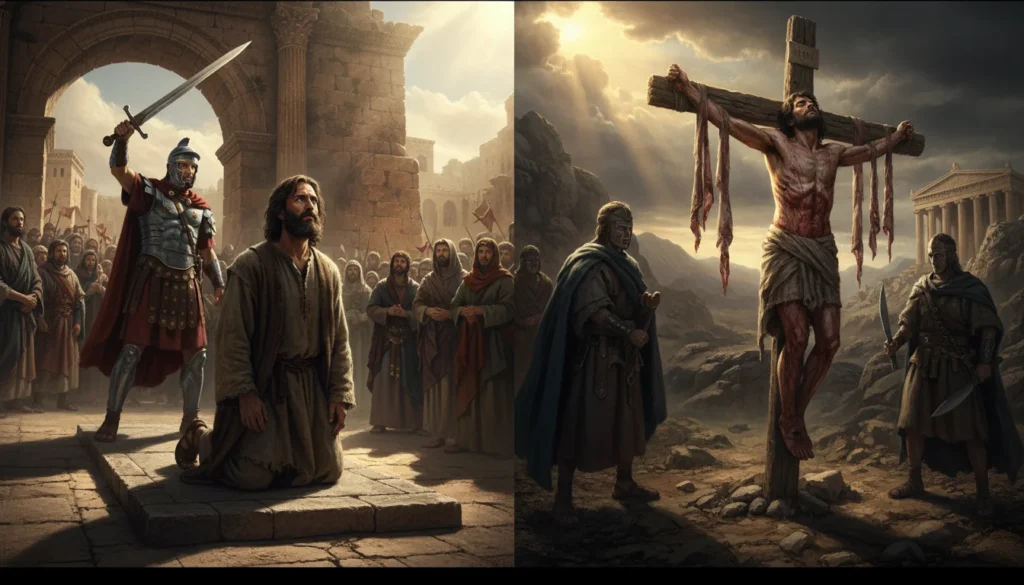
James, son of Zebedee and brother of John, was the first of the apostles to drink the cup of martyrdom.
We read in the book of Atos that King Herod Agrippa ordered his death by the sword.
His swift execution was intended to intimidate the early church, but the effect was exactly the opposite.
James's courage in the face of the sword inspired the others to remain steadfast in promise of the Kingdom.
Bartholomew, also known as Nathanael, faced one of the most brutal fates in history.
He brought the good news to Armenia, where he defied the local gods and converted crowds.
In retaliation, he was skinned alive and was later crucified by the enemies of the faith.
We were appalled by such brutality, but impressed by their spiritual resilience.
His skin was stripped away, but his soul remained intact and focused on the heavenly reward.
These sacrifices show us that persecution does not discriminate in its methods, but faith does not choose what is convenient.
James and Bartholomew are examples of how the cost of discipleship can be extremely high.
We looked at their stories and realized that the world was not worthy of these men of God.
André and Filipe: The Cross and the Stone
André, the first to be called, dedicated his life to preaching in the regions of what is now Greece.
His martyrdom took place in Patras, where he was sentenced to die on a X-shaped cross.
We know this symbol today as the “Cross of Saint ”André,” a testament to his total dedication.
Tradition has it that he preached to the crowd for two days while he was hanging there.
He refused to be taken down from the cross, longing to meet his Lord through the final sacrifice.
Philip, the apostle who asked to see the Father, followed a similar path of suffering in Asia Minor.
In Hierapolis, his preaching against idolatry enraged the local authorities and priests.
We know that he was severely flogged, imprisoned, and finally, stoned and crucified.
His death was a combination of different methods of execution, demonstrating the world’s hatred of the Truth.
Even in the face of the stones and the cross, Philip did not renounce the name of Jesus Christ.
The variety of forms of sacrifice shows that the enemy tried everything to silence the apostles.
We have realized that, regardless of the method, the spiritual victory was absolute in all of them.
The Life and Death of the Apostles is a thrilling journey back to the apostolic era, when the twelve men chosen by Jesus of Nazareth to spread Christianity to the ends of the earth gave their lives in response to the irresistible call to serve God. Learn how the apostles of Christ lived, preached, and died.
Thomas and Matthew: The Mission and the End
Thomas, often remembered for his initial doubt, demonstrated unparalleled missionary courage.
He traveled to the distant lands of India, bringing the Gospel to places where Christ was not yet known.
We admire your willingness to cross geographical and cultural boundaries for the sake of the Kingdom.
His end came at the hands of soldiers who pierced him with four spears while he was praying.
The apostle who had to touch Jesus’ wounds now offered up his own wounded body.
Matthew, the former tax collector who wrote the first Gospel, set out for Ethiopia.
He gave up the comforts of earthly riches to seek out lost souls on the African continent.
We have read reports that he was beheaded by the sword while serving at a local church.
His pen, which recorded the Master’s teachings, was stained with the blood of martyrdom.
Both Thomas and Matthew show that the Christian mission knows no territorial boundaries.
They died far from home, but very close to God’s heart and to His eternal promise.
We are the heirs of that missionary zeal that fears neither distance nor violent death.
Simon Judas Thaddeus and the Legacy of Faith
Simon the Zealot and Judas Thaddeus are often mentioned together in connection with their final missions.
We see that they brought the message of salvation to the arid regions of ancient Persia.
Both faced the wrath of local wizards and priests who felt threatened by the Light of Christ.
Simon is said to have been killed by being sawed in half, a fate of unimaginable suffering.
Judas Thaddeus, the author of the epistle that bears his name, was martyred by blows from an axe or a club.
We reflected on how these men, with such different personalities, came together for the same purpose.
Their martyrdom was not the end, but a seal of authenticity for their faith.
Below is a summary of the legacy left by these pillars of the Christian faith:
- Unwavering Loyalty: Not a single apostle denied Christ to save his own life.
- Global Expansion: They died on different continents while spreading the Gospel.
- Foundation of the Church: Their blood cemented the doctrines we follow to this day.
- Eternal Inspiration: Their example continues to encourage persecuted Christians around the world.
We understand that the legacy of these men is the very existence of the contemporary Church.
Their lives were offered as living sacrifices, and their deaths were the final statement of the truth.
As we reflect on the fate of the apostles, we are renewed in our own faith and commitment.
May the courage of these pillars inspire us to live each day for the glory of our Lord Jesus.
The Enduring Echo of Apostolic Sacrifice
As we reflect on how the apostles died, we are invited to reflect deeply on the power of faith and the price of truth. Their lives and deaths are not merely stories from the past, but an ongoing call to perseverance and unconditional love.
May these stories inspire you to live out your faith more deeply. Share your thoughts in the comments and help us spread this message of hope and resilience!
FAQ – Common Questions About How the Apostles Died
We have prepared this FAQ to address the most common questions about the ultimate sacrifice of Christ’s followers and to strengthen your spiritual journey with us.
The apostle John He was the only one of the original group to die of natural causes, at an advanced age in the city of Ephesus. Although he faced persecution and exile on the island of Patmos, he passed away peacefully after fulfilling his prophetic mission.
Peter was crucified on upside down in Rome, because he did not consider himself worthy to die in the same way as the Lord. Paul, on the other hand, because he held Roman citizenship, was beheaded, sealing his testimony of faith in the capital of the Empire.
Understand how the apostles died helps us gauge the depth of their conviction and the truth of the message they preached. The sacrifice of these men is the historical and spiritual foundation upon which our faith was built and strengthened.
A Bible explicitly records only the martyrdom of James, son of Zebedee, in the Book of Acts. Details about the fate of the other apostles have come down to us through the early Christian tradition and the accounts of early Church historians.
The pillars of the faith died scattered across various nations, such as Rome, India, Ethiopia, and Persia, as they carried out the “Great Commission.” This geographical dispersion proves that they took the Gospel to the ends of the earth, regardless of the risks they would face.