Biblical quotations: Almeida Revista e Corrigida (ARC, 1898).
Matthew 4: The Journey into the Desert. After being baptized, Jesus is led by the Spirit into the desert, where he fasts for forty days and is tempted by the devil. It is one of the best-known accounts in the New Testament and offers practical lessons on faith, temptation, and trust in God.
In this article, you'll learn about the three temptations of Jesus, how he responded to each one, and what this teaches us about life today.
- the context of Matthew 4;
- the three temptations in the desert;
- Jesus' answers based on the Scriptures;
- lessons for the Christian life.
The Importance of Matthew 4
Chapter 4 of Matthew has 25 verses. The first eleven describe the temptation in the desert. The rest recount the beginning of Jesus’ ministry in Galilee and the calling of the first disciples.
The temptation occurs immediately after the baptism, when a voice from heaven declares Jesus to be the beloved Son of God (Matthew 3:17). That is why the devil begins two of the temptations with the phrase “If you are the Son of God”: he attacks Jesus’ very identity.
| Temptation | What the Devil Proposed | Jesus' Response |
|---|---|---|
| 1st: Stones in bread Matthew 4:3-4 | Using Power to End Hunger | Man shall not live by bread alone (Deut. 8:3) |
| 2nd: Temple spire Matthew 4:5-7 | If you gamble to prove God's protection | You shall not put the Lord your God to the test (Deut. 6:16) |
| Tuesday: Kingdoms of the World Matthew 4:8-10 | Power and glory in exchange for worship | You shall worship the Lord your God (Deut. 6:13) |
In the following sections, we'll look at each temptation in detail.
Temptation in the Desert: A Divine Test
The story begins like this:
“Then Jesus was led by the Spirit into the wilderness to be tempted by the devil. After fasting for forty days and forty nights, he became hungry.”
Matthew 4:1-2 (ARC)
Jesus spent forty days and forty nights in the desert, fasting and in isolation. It was the Spirit who led him there, which shows that this period was part of the beginning of his ministry.
It was during this moment of physical weakness that the tempter appeared, offering three temptations that tested Jesus’ trust in God.
The First Temptation: Stones in Bread
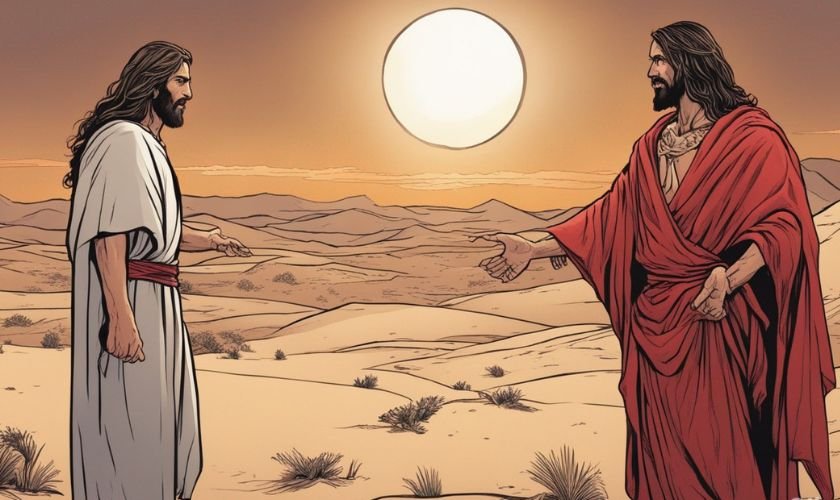
In verses 3 and 4, the first temptation occurs. Jesus was hungry, and the tempter approached him:
“If you are the Son of God, command these stones to turn into loaves of bread.”
Matthew 4:3 (ARC)
The devil challenges Jesus to prove his identity by turning stones into bread.
The temptation goes beyond physical hunger. It suggests that Jesus use his powers to meet a personal need, rather than wait for the Father’s care.



Jesus' Response
Jesus responds with a passage from the Scriptures:
“It is written: ”Man shall not live by bread alone, but by every word that comes from the mouth of God.’”
Matthew 4:4 (ARC)
Jesus quotes Deuteronomy 8:3, a passage that recalls the people of Israel in the wilderness, sustained by God with manna. He places the Word of God above material needs.
Jesus does not use his power to meet an immediate need and continues to trust in God's will.
The Second Temptation: The Leap from the Temple Pinnacle
The second temptation, in verses 5 through 7, has an interesting detail: this time, the devil himself quotes Scripture.
“If you are the Son of God, throw yourself down from here; for it is written: ”He will command his angels concerning you, and they will lift you up in their hands, so that you will never strike your foot against a stone.’”
Matthew 4:6 (ARC)
The devil takes Jesus to the highest point of the temple, quotes Psalm 91:11–12, and challenges him to throw himself down so that God would save him in front of everyone. The temptation involves real physical danger and tests Jesus’ trust in God.
Jesus responds with another passage, from Deuteronomy 6:16:
“It is also written: ”You shall not put the Lord your God to the test.’”
Matthew 4:7 (ARC)
The Third Temptation: Worshiping the Devil
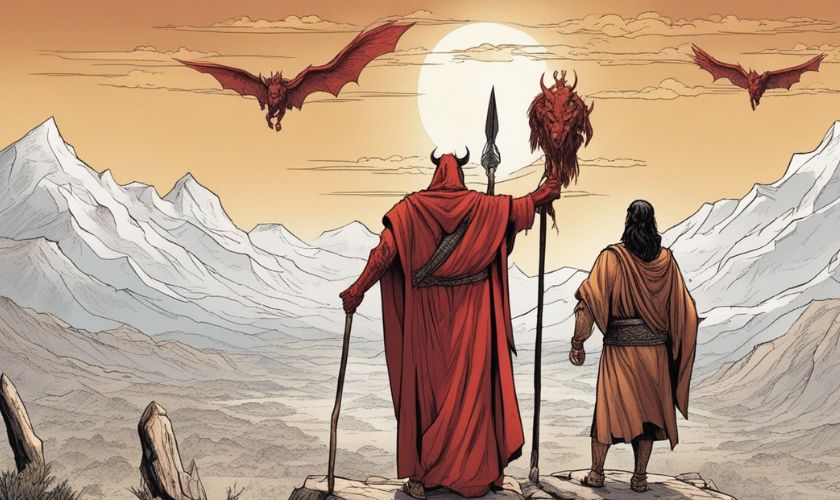
The third and final temptation, in verses 8 through 10, is the most direct. The devil takes Jesus to a very high mountain, shows him the kingdoms of the world, and makes the offer:
“I will give you all this if you fall down and worship me.”
Matthew 4:9 (ARC)
It is a temptation involving power, authority, and glory—without following the path the Father had laid out. Jesus resists once again by referring to Scripture, quoting Deuteronomy 6:13:
“Get behind me, Satan, for it is written: ”You shall worship the Lord your God and serve Him alone.’”
Matthew 4:10 (ARC)
The episode ends with Jesus' victory: in verse 11, the devil leaves him, and the angels come to serve him.
Conclusion
Chapter 4 of Matthew reveals Jesus’ humanity and divinity and teaches us how to resist temptation. With each attack, Jesus responded with the Word of God.
Some lessons that a Christian reading draws from this account:
- 📖Getting to Know the Word: Jesus responded to the three temptations with passages from the Scriptures.
- 🙏Trusting without testing: Faith trusts in God, but does not put Him to the test.
- 👑Worship God alone: No power or glory justifies giving that up.