Introduction:
The book of Exodus, the second book of the Old Testament, tells a story of oppression and liberation that has resonated through the centuries. In its first chapter, we are immersed in the story of the children of Israel, who were living under the yoke of an oppressive Egypt.
This biblical passage not only describes the crucial events of that time but also sheds light on God’s promise to free His people from slavery. As we delve into this rich narrative, we are confronted with the exponential growth of the Israelites, Pharaoh’s wicked decree, and the unwavering courage of the Hebrew midwives.
In this context, the growth of the Israelites’ numbers serves as the starting point for the unfolding story. The promise made to Abraham The promise of a large family is beginning to come true before our very eyes.
The Israelites multiply rapidly, like seeds sown in fertile soil. This growth, however, alarms the Egyptian leaders, who see the expanding Hebrew population as a potential threat. Thus, we are introduced to the intricate web of events that will culminate in the rise of Moses as the leader and liberator of the people of Israel.
As we delve into this ancient account, we are led to reflect on God’s faithfulness, as He fulfills His promises even in the midst of the most difficult trials.
The Prosperity and Oppression of the Children of Israel
The proliferation of the children of Israel on Egyptian soil was a remarkable phenomenon. In a short time, the small Hebrew community became an impressive demographic force, a living testimony to God’s faithfulness to the promise made to Abraham. The population, which had once been counted on one’s fingers, was now counted in the hundreds and, later, in the thousands.
This exponential growth did not go unnoticed by the Egyptians, who began to view the Israelites as a threat to the stability of the kingdom.
As the Hebrews multiplied, tensions in Egypt began to rise. The pharaoh, fearful of the Israelites’ growing influence, took drastic measures to maintain his rule. It was in this context that oppression began to manifest itself in a cruel and relentless manner.
The Israelites were subjected to forced labor, compelled to build cities and monuments for the Egyptian empire. The prosperity that had once been celebrated had now become the catalyst for overwhelming oppression.
This contrast between growth and oppression serves as the backdrop for the events that unfold in Exodus 1, marking the beginning of the liberation saga that is about to unfold.
The Courage of the Hebrew Midwives
The narrative of Exodus 1 nos presenteia com um exemplo notável de coragem nas figuras das parteiras hebreias, Sifrá e Puá. Diante do decreto cruel do faraó de eliminar os recém-nascidos hebreus, essas women destemidas se recusaram a obedecer. Elas demonstraram uma bravura extraordinária ao desafiar as ordens diretas do monarca e optar por preservar vidas inocentes.
The courage of Shifra and Puah not only saved countless children from imminent death, but also symbolizes the resilience and determination of the Hebrew people in the face of oppression. Their fearless actions are a powerful reminder that, even in dark times, individual courage can be a light guiding the way toward justice and freedom.
These midwives became heroines, defying the oppressive system and showing that hope was far from lost.



Attempted Genocide and Divine Providence
The pharaoh, determined to curb the growth of the Israelites, issued an inhumane decree: all Hebrew newborns were to be cast into the Nile River. This draconian decree reveals the cruelty of the Egyptian regime, which was willing to resort to genocide to maintain its control.
However, divine providence was at work, setting the stage for God’s intervention in the history of his people.
It is against this bleak backdrop that we witness the courage of Jochebed, Moses’ mother, who faced the agonizing dilemma of protecting her son from the death sentence imposed by the pharaoh. With a mixture of cunning and faith, she wove a basket of reeds and sealed it with bitumen and pitch, providing fragile but effective protection for little Moses.
When she placed the basket in the waters of the Nile, Jochebed entrusted her son’s fate to God’s care, in an act of faith that would set in motion a chain of events that would change the course of history.
Paradoxically, the attempted genocide became the means through which God acted in a surprising way to preserve Moses and prepare him for the monumental role he would play in the liberation of Israel.
The Birth and Concealment of Moses
The birth of Moses is a pivotal moment in the narrative of Exodus 1. After being hidden for three months by his mother, Jochebed, he was placed in a basket made of reeds and set adrift on the Nile, entrusting his fate to divine providence. It was then that he was discovered by Pharaoh’s daughter, who, upon seeing him, was moved with compassion and decided to adopt him as her own son.
This pivotal moment not only saved Moses’s life, but also placed him at the heart of the Egyptian court, preparing him for the role he would play in the liberation of his people.
Moses’ concealment and subsequent discovery were not merely chance occurrences, but rather evidence of God’s direct intervention in the history of his people. Jochebed’s decision to trust in God and her courage in placing Moses in the waters of the Nile were not in vain.
Divine providence was weaving the threads of history, preparing Israel’s deliverer in the very halls of Pharaoh’s palace. This episode is a powerful reminder that, even in the darkest moments, God is working behind the scenes to fulfill his purposes and free those who are under oppression.
Moses: From Prince to Liberator
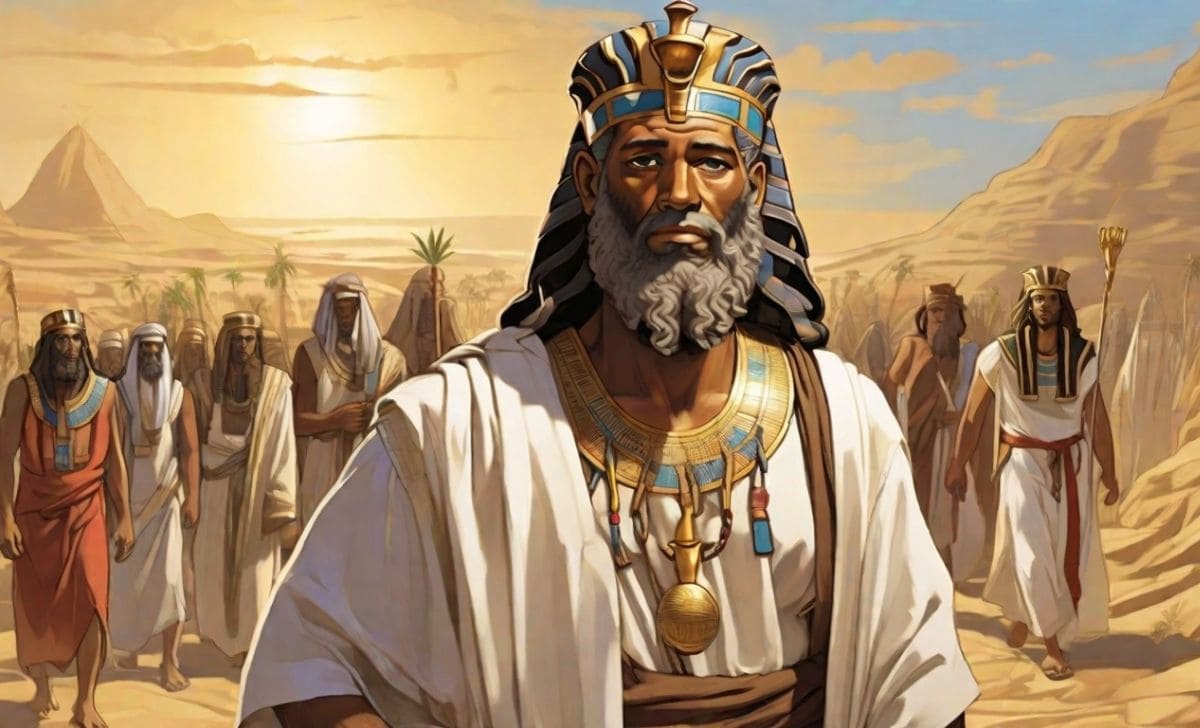
Raised in the sumptuous halls of the Egyptian palace, Moses was brought up as a prince, immersed in the culture and customs of the court. However, as he grew older, he could not ignore the disconnect between his Hebrew identity and the oppression his people were suffering.
This inner conflict led him on a journey of discovery and discernment, culminating in a moment of decisive clarity. Upon witnessing an Egyptian mistreating a Hebrew, Moses could no longer contain himself. He took action, defending his blood brother, revealing his loyalty to his true lineage, and standing in solidarity with the oppressed.
This rash action, however, had drastic consequences. Moses was forced to flee Egypt, leaving behind his life of privilege. He found refuge in the land of Midian, where, amid isolation and reflection, he began to understand the greater purpose God had in store for him.
This transition from prince to shepherd marked the beginning of his journey toward his role as leader and liberator of his people. Moses was being prepared behind the scenes of obscurity for the monumental role he would play in the history of Israel, a transformation that illustrates how God often shapes and trains His chosen ones in moments of apparent obscurity and distance.
Reflections on God's Sovereignty and Hope in Adversity
The story of Exodus 1 invites us to contemplate God’s unshakable sovereignty, even in the face of the bleakest circumstances. He was at work behind the scenes, orchestrating events and preparing Moses for the role he would play in the liberation of his people.
This story serves as a reminder that, even when we face oppression and adversity, God is working on our behalf, fulfilling His plans for our lives.
In addition, Exodus 1 offers us a powerful lesson in hope. Even when all seems lost and oppression seems insurmountable, history reminds us that God is able to transform seemingly hopeless situations into opportunities for liberation and redemption. The experience of the children of Israel in Egypt is a lasting testimony that hope in God is not in vain.
Therefore, we can find comfort and encouragement in the certainty that, even in the most difficult moments, God is with us, bringing hope and deliverance.
Closing:
As we reflect on the opening chapter of Exodus, we are reminded of the complexity and depth of the biblical narrative. The multiplication of the children of Israel, the courage of the Hebrew midwives, the attempted genocide and divine providence, the birth and hiding of Moses, his journey from prince to shepherd, and reflections on God’s sovereignty and hope in adversity—all these elements intertwine to form a tapestry rich in meaning and relevance for our lives today.
It is a timeless story that teaches us lessons in courage, faithfulness, and trust in God, even in the face of the most challenging circumstances. The story of Exodus 1 is a vivid reminder that, just as God acted in a sovereign way in the lives of Moses and the Israelites,
He continues to work in our lives today, guiding us and setting us free from the bonds of oppression. May we find inspiration and encouragement in this timeless story, and as we face our own adversities, may we remember that we serve a God who is faithful to fulfill His promises and lead us to freedom.
That the narrative of Exodus 1 resonate in our hearts, reminding us of the importance of trusting in God amid life’s storms.
See also: Acts 1: Call to Action