In the vast panorama of sacred texts, the book of Genesis acts as a window into the beginning of everything. Although many focus only on the creation of the world, there is one passage that deserves our attention: the Chapter 5.
More than a list of names, this chapter traces the roots of humanity and brings eternal lessons about life, faith and the passage of time. Join us on this journey between Adam and Noah.
Genealogy as a Conducting Thread
When we open Genesis 5, we are plunged into a succession of generations. The text begins with a strong phrase: “This is the book of Adam's descendants”.
This register is not just used to tell who was born to whom. It is common thread which connects the divine creation to human destiny. Each name represents a life that has carried faith, perseverance and hope through the centuries.
The Mystery of Longevity
What is most striking about this chapter are the ages of the patriarchs. Adam lived 930 years; Seth, 912; and Methuselah reached 969 years. Figures that challenge our current reality.
How to interpret these years?
There are various views on this impressive longevity:
- Literal: Some believe that the climatic and biological conditions of that era allowed for longer lives.
- Symbolic: Others argue that the numbers convey spiritual and mystical messages about the importance of that generation.
- Wisdom: Prolonged time can be seen as a journey of accumulating experiences and an incessant search for the divine.
Lessons Beyond the Numbers
The richness of Genesis 5 goes beyond counting the years. The text invites us to reflect on:
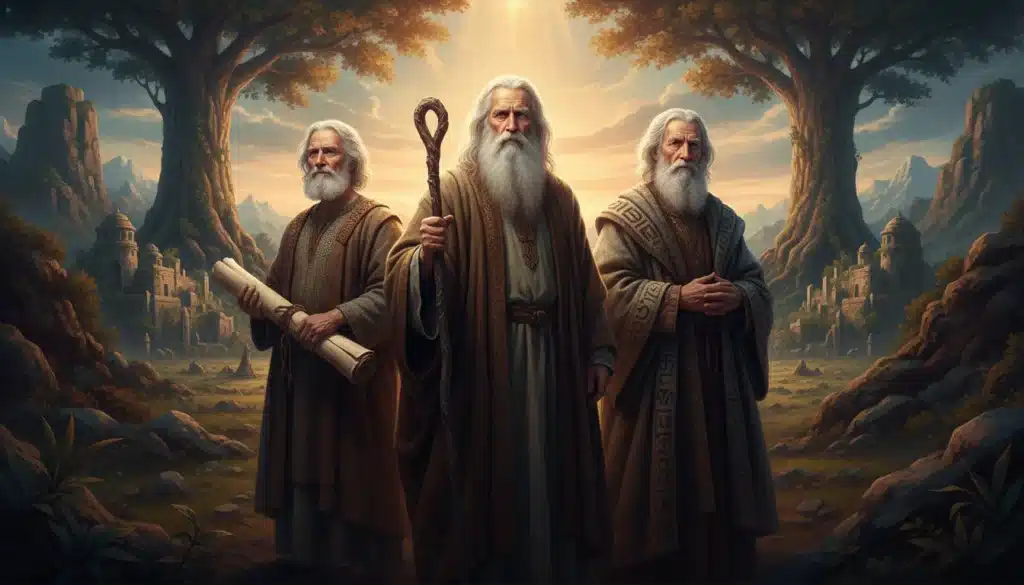
- Our Roots: It reminds us of the importance of honoring those who came before us. We are part of a much larger plot in history.
- Spiritual Legacy: The life of Enoch, for example, who “walked with God”, shows that the depth of our connection with the Creator is what really defines our trajectory, no matter how many years we live.
- Accumulated Wisdom: The passage of time should be an invitation to seek answers about the meaning of our existence.



Conclusion: Navigating Spiritual Knowledge
To contemplate Genesis 5 is to look through a portal that unites the past and the future. Behind the ancient names, we find a call to understand our own connection with the divine.
Just as a river carries the history of the lands it passes through, the words in this chapter carry truths that transcend time. Don't look at these verses just as a list, but as proof of our spiritual essence.
Article Updated
- The genealogy of Genesis 5 serves as an essential bridge, connecting the creation of Adam to the flood with Noah, reaffirming the continuity of the human and divine lineage through a concise narrative.
- Antediluvian longevity, although enigmatic, invites reflections on deep spiritual life and the accumulation of wisdom over prolonged existences, challenging our temporal understanding.
- More than a list of names and ages, Genesis 5 offers timeless lessons about our roots, the importance of faith and the never-ending search for a greater purpose within the divine plan for humanity.
Understanding the Antediluvian Timeline in Genesis 5
For a clearer understanding of the sequence and longevity of the patriarchs mentioned in Genesis 5, check out the table below which summarizes the main information, illustrating the transition of generations until the arrival of Noah:
| Patriarch | Age at childbearing | Total Years of Life | Notable observations |
|---|---|---|---|
| Adam | 130 | 930 | The first man, the father of humanity, lived for almost a millennium. |
| Seven | 105 | 912 | Son of Adam, substitute for Abel, he kept the lineage of promise. |
| Enos | 90 | 905 | Son of Seth, during his time the people began to call on the name of the Lord. |
| Cainan | 70 | 910 | Grandson of Seth, one of the long-lived before the flood. |
| Maalalel | 65 | 895 | Jared's father, contributing to the continuity of the genealogy. |
| Jared | 162 | 962 | Father of Enoch, one of the longest-lived patriarchs. |
| Enoch | 65 | 365 | He walked with God and was not found, because God took him, a unique event. |
| Methuselah | 187 | 969 | The oldest man in the Bible, Noah's grandfather. |
| Lameque | 182 | 777 | Noah's father, he foresaw the rest that Noah would bring to the earth. |
| Noah | 500 | 950 | Son of Lamech, the builder of the ark and post-diluvian patriarch. |
Frequently Asked Questions about Genesis 5 (FAQ)
What is the main function of the genealogy in Genesis 5?
The main function of the genealogy in Genesis 5 is to establish the direct lineage from Adam to Noah, guaranteeing the continuity of the divine promise and setting the stage for the events of the Flood, connecting humanity from its origins.
Why did the patriarchs live so many years in Genesis 5?
The longevity of the patriarchs in Genesis 5 is a matter of debate, but it is generally interpreted as a reflection of the ideal conditions before the Flood, a divine blessing, or even a literary resource to emphasize the importance of these figures in salvation history.
Who was Enoch in Genesis 5 and what was his importance?
Enoch, in Genesis 5, is notable for “walking with God” and for not experiencing death, being taken by God at the age of 365. His importance lies in being an example of piety and faith in an age of increasing iniquity.
Genesis 5 mentions “death” repeatedly. What does this symbolize?
The repeated mention of “death” in Genesis 5 symbolizes the consequence of Adam's sin, the universality of human mortality, and serves as a reminder of the fragility of life, contrasting with the eternal life promised by God.
What is the relationship between Genesis 5 and the Flood?
The relationship between Genesis 5 and the Flood is that chapter 5 establishes the lineage that culminates in Noah, the central character of the Flood narrative in Genesis 6. It ensures that the offspring for salvation has been preserved.