
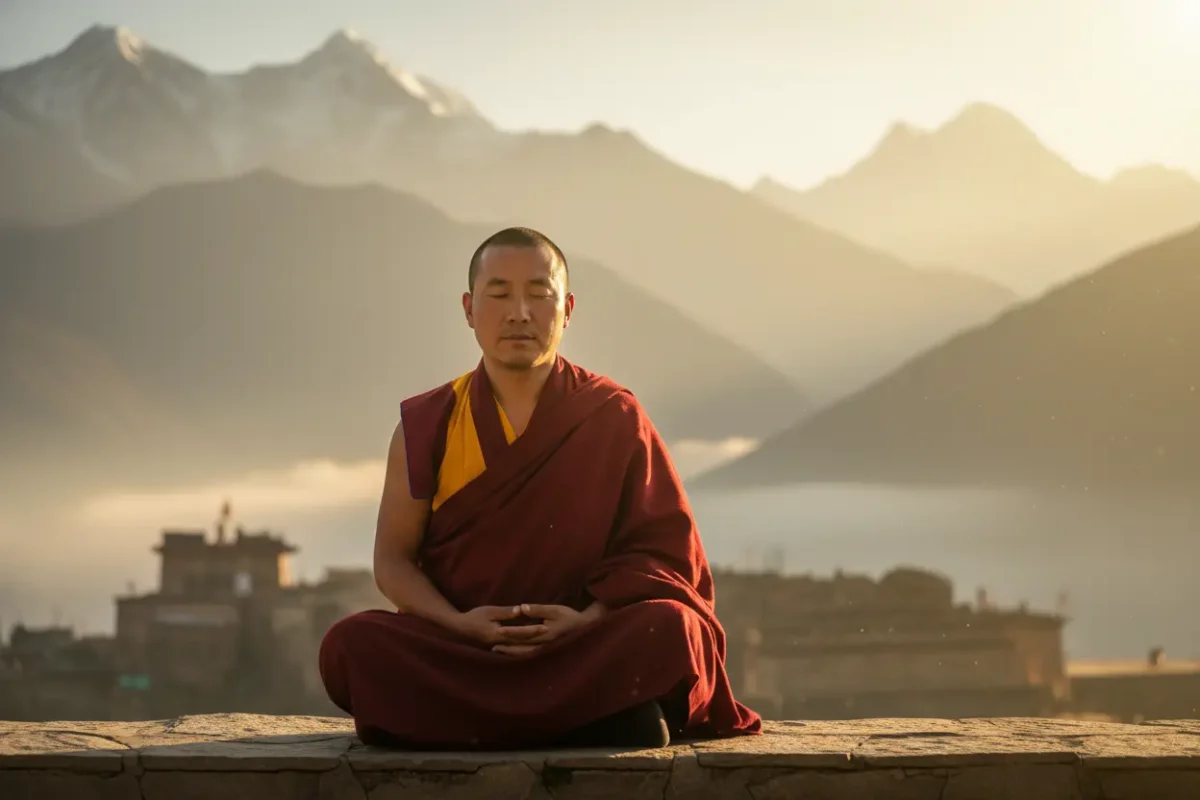
Amid the whirlwind of modern life, many people long for a haven of calm and meaning. The search for a more fulfilling life connected to the divine is universal, and leads us to explore different paths and philosophies.
Today, we're going to look at the fascinating life of Tibetan monks and, through their practices of simplicity and devotion, find inspiration and profound reflections that can enrich our own journey of faith and search for inner peace.
The Life of Tibetan Monks A Quest for Peace
We look to the top of the Himalayan mountains and imagine a scene of absolute isolation. There, where the air is thin and the cold punishes the skin, how tibetan monks live in a harmony that seems impossible to us? The secret lies not in the altitude, but in the depth of their souls. They dedicate every beat of their hearts to an incessant search for something we all desire: serenity.
Walking through the corridors of a monastery is like entering a time that doesn't obey the clock. The sound of mantras and the scent of incense create an atmosphere of constant reverence. For these men, life is not a race for external achievements, but a journey into themselves. They understand that the external noise is just a reflection of the internal chaos that has not yet been mastered.
We, who often feel suffocated by routine, can learn from this delivery. A spirituality Theirs is lived in detail, from waking up before the sun to the moment of rest. There is no room for the superfluous when the focus is on enlightenment and compassion for all beings. Every gesture, no matter how simple, becomes an act of worship and presence.
Think about it for a moment. How many times have you stopped today to just breathe and give thanks for life? Monks make this their profession of faith. They show us that peace is not a destination, but the very path we choose to walk every day. It's an invitation to slow down and listen to what our soul has been trying to tell us for so long.
This search for peace is not exclusive to one culture or geographical region. It is a universal cry of humanity that longs for rest. Observing the discipline of these religious people, we realize that true freedom comes from self-discipline. They give up a lot to gain what really matters: clarity about who they are and where they are going.
Simplicity and Detachment Lessons for the Soul
Living with little seems like a daunting challenge in a society that asks us to always have more. However simplicity is the foundation on which the monks build their happiness. They have only the essentials: their robes, an alms bowl and the faith that sustains them. This material lightness allows the spirit to fly higher, without the weights we usually carry.
Detachment doesn't mean not having anything, but rather not letting anything possess us. When we become too attached to material possessions, we end up becoming slaves to our own possessions. Tibetan monks teach us that the soul breathes better when the closet is empty of vanities. It's a hard lesson, but extremely liberating for those seeking the Kingdom of God.
We often believe that happiness lies in the next purchase or the next level of comfort. However, true joy blossoms in gratitude for what we already have. By simplifying the routine, we make room for the divine to manifest itself in unexpected ways. Less visual and material noise results in more spiritual and emotional clarity to face the difficult days.
It's worth reflecting: what are you carrying today that could be left behind to make your journey lighter? Detachment also applies to old feelings, hurts and excessive worries about tomorrow. By imitating this attitude of detachment, we begin to realize that divine providence takes care of every detail. Trust replaces fear when we understand that we don't need much to be whole.
Monastic life is a mirror that shows us how complicated our existence is. They don't seek luxury, because they have discovered that peace is the greatest treasure anyone can possess. May we take some of this sacred minimalism into our homes and hearts. May our search for happiness be guided by being, and not just by having.
Meditation and Prayer The Connection with the Divine
There is an invisible bridge linking Eastern meditation and Christian prayer. Both seek the same horizon: deep communion with the Creator and the elevation of the spirit. While the monk sits in silence to empty his mind, the Christian kneels to fill his heart with the presence of God. A devotion is the fuel that keeps this flame burning, regardless of what we call the act.
In particular, I believe that prayer gains extraordinary strength when we learn to be silent. I've been through times when my words seemed to hit the ceiling and come back, simply because I was talking too much and listening too little. It was by experiencing small moments of quiet, inspired by this monastic discipline, that I began to hear the Lord's still, small voice. It is in silence that God usually whispers His most precious secrets to us.
We need to understand that meditation is not a distant mystical practice, but an exercise in mindfulness in the divine presence. When we meditate on the Word, we are chewing on God's promises until they become part of our blood. Monks spend hours in recitation, creating a rhythm that calms the nervous system and focuses intention. We can do the same with the Psalms, and turning each verse into a sigh of adoration.
Connecting with the divine requires time and intention, something rare in our timed days. It's not about fulfilling a religious task, but about cultivating a relationship of love. Prayer is the breath of the soul, and without it, our faith becomes dry and mechanical. By observing the monks' constancy, we are challenged to rescue our own spiritual discipline with greater zeal.
Learning to be present in the “here and now” is one of the greatest lessons that meditation offers us. God is the “I Am”, and He is to be found in the present, not in the anxieties of the future or the regrets of the past.
When we silence the noise of the world, the frequency of heaven becomes audible to our spiritual ears. It's a meeting of souls that transforms our perception of life and ourselves.



Verses on Inner Peace and Contemplation
The Holy Bible is a wellspring of tranquil waters for those who seek to inner peace. Just as the monks find direction in their sacred texts, we have the living Word that illuminates our path.
These verses are like balms that heal the agitation of the mind and bring the rest that only the Holy Spirit can provide.
Contemplating the Scriptures is an exercise in constant mental and spiritual renewal. When we keep these words in our hearts, they become shields against the storms of life. Here are some passages that are true refuges for your soul:
- “You will keep him in peace whose mind is stayed on you, because he trusts in you.” (Isaiah 26:3)
- “Peace I leave with you, my peace I give to you; not as the world gives do I give it to you. Let not your heart be troubled, neither let it be afraid.” (John 14:27)
- “Be still, and know that I am God; I will be exalted among the nations; I will be exalted above the earth.” (Psalms 46:10)
- “The Lord is my shepherd, I shall not want. He makes me lie down in green pastures; he leads me beside still waters.” (Psalm 23:1-2)
- “And the peace of God, which surpasses all understanding, will guard your hearts and your thoughts in Christ Jesus.” (Philippians 4:7)
Read each of these phrases slowly, allowing them to penetrate the deepest layers of your being. Notice how biblical peace does not depend on external circumstances, but on an anchor in eternity. While the world spins in confusion, the Word keeps us safe and centered in the Father's will.
Reflecting on these teachings brings us closer to that serenity we see in the eyes of those who live for faith. Contemplation is not passivity; it is an intense activity of trust and total surrender. May these verses be your lullaby on sleepless days and your cry of victory on days of struggle.

The Power of Silence and the Voice of God
Silence is often the most eloquent language we can speak to the Creator. We live surrounded by notifications, music, traffic and empty conversations that compete for our attention. Monks value silence not as the absence of sound, but as the presence of meaning. They know that the great truths of life are not usually shouted in the public square.
God revealed himself to Elijah not in a strong wind, earthquake or fire, but in a gentle chime. If we are always talking or listening to the noise of the world, we will hardly notice this subtle touch. Silence confronts us with who we really are, without the masks we wear to interact with others. It's a mirror that, although sometimes frightening, is necessary for our spiritual growth.
Practicing silence requires courage in a culture that is terrified of emptiness. Yet it is in this emptiness that the seed of divine revelation finds fertile soil to germinate and grow. Try setting aside ten minutes of your day to say nothing, just to be before God in stillness. You will notice that your anxiety will begin to diminish as your soul finds its center.
I remember a time when everything seemed confusing and the answers wouldn't come no matter how much I asked. So I decided to go on a “word diet” for a whole day, focusing only on the essentials. What I discovered was surprising: the answer was already there, but I was making too much noise to notice it. Silence cleanses the ears of the heart and prepares us to obey more readily.
We don't need to go to a cave in Tibet to experience the power of stillness. We can create a “war room” or prayer corner where the outside world is not allowed to enter. There, in secrecy, the greatest battles are won and peace is restored to our minds. Silence is the womb where wisdom is generated and faith is strengthened.
Find Your Purpose on the Journey of Faith
Each of us has a purpose A unique mission that justifies our existence on this plane. Monks find their purpose in intercessory prayer and in seeking enlightenment for the good of all. We, inserted in society, find our purpose in serving as a light wherever the Lord places us. Faith is not a retreat from reality, but a force that enables us to transform it.
Discovering what we were created for brings a sense of urgency and joy that nothing else can offer. When we align our will with God's will, life ceases to be a burden and becomes an adventure. Purpose works like a compass that guides us through the mists of doubt and discouragement. It gives us reasons to get out of bed with hope, even when the days seem gray.
Many people spend their entire lives looking for success, when in reality what they're looking for is meaning. Success is what others see; purpose is what your soul feels when you do what you were born to do. It doesn't matter whether you're a teacher, a doctor, a janitor or a monk at a mountain distant. What matters is the intensity of the love and faith you put into every little action.
Think of life as a great tapestry where each thread has its place and its specific color. If a thread is missing or lost, the design becomes incomplete and loses its original beauty. You are an essential thread in God's work, and your purpose is to shine with the color He has given you. Don't try to imitate someone else's journey, but honor the story that the Creator is writing through you.
The journey of faith is made up of daily steps, often small and imperceptible to the eyes of the world. However, each step taken towards the eternal purpose resonates for eternity. May we have the discipline of the monks and the passion of the apostles to fulfill our career with joy. The peace we so desperately seek is closely linked to our obedience to the call we have received from on high.
Share the Peace That Overflows in You
We have reached the point where peace ceases to be an individual benefit and becomes a blessing for others. When we find this rest in God, it naturally begins to overflow through our words and attitudes.
We can't keep such a great treasure to ourselves, at the risk of it losing its luster. Peace is contagious and has the power to calm the restless hearts around us.
Imagine the impact we would have if every Christian decided to be an agent of serenity in the midst of chaos. Instead of reacting with anger, we could respond with the gentleness we learn in prayer and meditation.
The world is hungry for real examples of people who possess a peace that surpasses all understanding. Be that beacon of calm and hope for your family, friends and colleagues.
We are called to be peacemakers, and this is one of the greatest marks of God's children. Sharing this peace can be as simple as offering a listening ear to someone who is suffering or a sincere smile to a stranger. Small gestures of kindness are seeds of eternity planted in the soil of everyday life.
Never underestimate the power of a sweet word said at the right time to someone who is on the brink of the abyss.
If this text has touched your heart and brought a little light to your journey, don't hesitate to pass it on. Someone you know may be in need of exactly this invitation to reflection and silence today. By sharing messages of faith and hope, we are fighting the darkness of despair that tries to dominate our time. Together, we can create a network of prayer and support that crosses borders and reaches out to weary souls.
May the peace of Christ, which the monks seek so zealously and which we receive by grace, always be with you. May your journey be light, your heart grateful and your faith unshakeable in the face of challenges.
Stay firm in your purpose, knowing that the Lord of the still waters walks beside you every step of the way. Go in peace and be yourself a channel of blessings for this world that so desperately needs love.
FAQ - Common questions about how Tibetan monks live
We've prepared this section to shed light on the main curiosities about monastic life and how these principles can inspire our own journey of faith.
They live in an extremely simple and disciplined way, dedicating most of the day to meditation, the study of sacred texts and community work. How Tibetan monks live is a direct reflection of the search for material detachment and constant spiritual elevation.
The central aim is to achieve enlightenment and inner peace by overcoming earthly desires and the ego. We can see in this dedication a parallel with our search for an a life of holiness and self-giving to the Creator's plans.
Of course, because silence is essential for calming our hearts and listening to God's voice. Just as in the life of monks, cultivating moments of stillness helps us to find discernment and peace amidst the noise of the modern world.
The Bible teaches us, in passages like Matthew 6:19-21, not to store up treasures on earth, but in heaven. The way how tibetan monks live reminds us of the importance of prioritizing what is eternal, keeping a heart focused on what really matters to the soul.
We can find this peace by setting aside daily moments of prayer and contemplation, inspired by monastic discipline. By understanding how tibetan monks live, We are encouraged to create our own “oasis of calm” through faith and full trust in the Lord.